
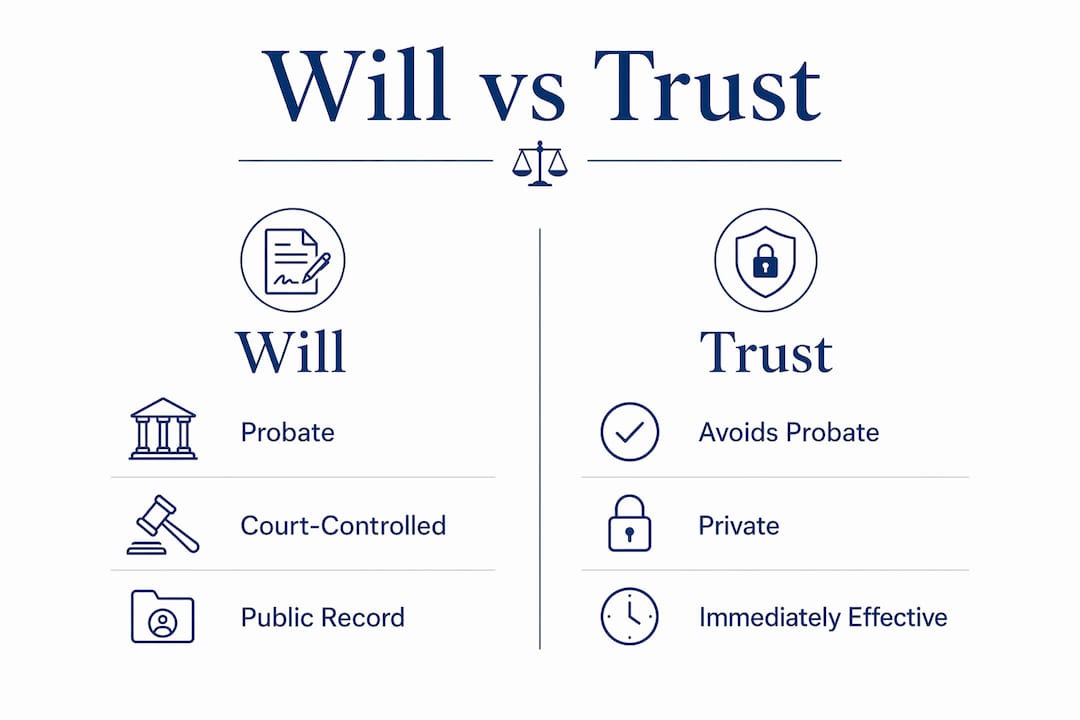
A will does not avoid probate. This surprises many families, but it’s one of the most important truths in estate planning. A will is a legal document that tells the probate court how you want your assets distributed and who should manage your estate. It works within the probate process, not around it.
Here’s what that means in practice:
-
Assets titled solely in your name at death almost always require probate, even with a perfectly drafted will.
-
The will itself has no power to transfer property. A court must first validate it through probate before any distribution can happen.
-
Non-probate transfers such as beneficiary designations, joint ownership with right of survivorship, and payable-on-death (POD) or transfer-on-death (TOD) accounts bypass probate entirely, regardless of what your will says.
-
A revocable living trust, when properly funded, keeps assets out of probate by changing ownership before death.
-
The size of your estate matters. Many states offer simplified procedures for smaller estates, which can reduce the time and cost involved.
Understanding this distinction is the first step toward building an estate plan that actually protects your family.
️ What probate is and how your will fits into it
Probate is the court-supervised legal process that validates a deceased person’s will, settles outstanding debts, and formally transfers titled assets to beneficiaries. Think of it as the legal bridge between what you owned in life and what your heirs receive after your death. Without it, titled property simply cannot change hands.
A will functions as a roadmap for the probate court, not a key to your assets. As the Texas State Law Library explains, “a will can’t be used to prove property transfer until it is validated by the courts.” The court schedules a hearing, examines the will, considers any objections, and, if satisfied, admits it to probate. Only then can an executor begin collecting assets, paying debts, and distributing what remains.
A will is a guide for the court, not a transfer mechanism. The actual movement of assets depends on probate validation and how property is titled at the time of death. A will that never enters probate cannot legally transfer titled property to your heirs.
Several key factors determine whether an estate must go through full probate:
-
How assets are titled: Property held solely in the decedent’s name requires probate. Property held jointly or with a named beneficiary does not.
-
The type of asset: Bank accounts with POD designations, retirement accounts with named beneficiaries, and life insurance policies pass outside probate entirely.
-
State law: Each state sets its own thresholds for simplified or summary probate procedures.
-
Whether a trust was funded: Assets properly transferred into a revocable living trust before death avoid probate because the trust, not the individual, owns them.
The probate court’s role is to protect everyone involved, including creditors, potential heirs who might contest the will, and beneficiaries who depend on a fair process. That oversight comes with a cost in both time and money, which is why so many families work to minimize it.
❌ Common misconceptions about wills and probate
The belief that having a will means avoiding probate is one of the most widespread misunderstandings in estate planning. It’s understandable. People spend time and money drafting a will, and they naturally assume that document handles everything. It doesn’t.

A will serves only as a guide for the probate court to distribute assets. It does not transfer property on its own. The court must first declare it valid before a single asset can legally move to a beneficiary.
Here are the misconceptions we hear most often:
-
“If I have a will, my family avoids probate.” Not true. Probate is typically required for any asset titled solely in your name, regardless of whether you have a will.
-
“Filing a will with the court is the same as opening probate.” These are two separate steps. Most states require that a will be filed with the probate court after death, but filing alone does not open a formal probate proceeding.
-
“A will controls all my assets.” A will only governs assets that pass through your estate. Retirement accounts, life insurance, and jointly held property follow their own transfer rules, completely independent of your will.
-
“A detailed will makes probate unnecessary.” No amount of detail in a will bypasses the court’s authority to validate it and oversee asset distribution.
Pro Tip: If your goal is to minimize probate, a will alone won’t get you there. Pair it with a revocable living trust, updated beneficiary designations, and properly titled assets to build a plan that actually reduces court involvement.
⚖️ When a will must go through probate
Probate is legally required in most situations where a person dies owning assets titled solely in their name. The type of asset and the total estate value both determine whether full probate or a simplified procedure applies.
Assets that typically trigger probate include:
-
Real estate held in the decedent’s name alone, without a joint owner or TOD deed
-
Bank accounts without a POD designation
-
Investment accounts without a TOD designation or named beneficiary
-
Personal property of significant value, such as vehicles titled solely to the decedent
-
Business interests held individually, without a succession agreement in place
State law sets the threshold for simplified probate. In California, for example, estates valued below a certain amount may qualify for a small estate affidavit rather than full court administration. New York has its own small estate procedures for qualifying estates. These simplified paths reduce cost and time considerably, but they are not available to every family.
Timing also matters. Most states require that a will be filed with the probate court within a specific window after death, often 30 days to several months depending on the jurisdiction. Missing that deadline can create legal complications for the executor and beneficiaries alike.
Statistic callout: The American Bar Association notes that simplified probate processes exist for small estates, reducing both cost and time. Probate is not always the financial burden people fear, but for larger or more complex estates, costs and delays can be substantial.
Full probate can take anywhere from several months to well over a year, depending on the state, the complexity of the estate, and whether anyone contests the will. Attorney fees, court filing fees, and executor commissions all reduce what ultimately passes to your beneficiaries.
️ How to avoid probate even when you have a will
You can significantly reduce or eliminate probate exposure through a combination of estate planning tools. A will remains a necessary part of any complete plan, but it works best alongside instruments designed specifically to transfer assets outside of court.
The most effective tools include:
-
Revocable living trust: A revocable living trust keeps assets out of probate by changing the ownership record before death. The trust owns the assets, not you individually, so there is nothing for the probate court to administer.
-
Beneficiary designations: Naming beneficiaries on retirement accounts, life insurance policies, and bank accounts creates a direct transfer at death. These assets bypass probate entirely, regardless of what your will says.
-
Joint ownership with right of survivorship: When two people own property jointly with this designation, the surviving owner automatically inherits the deceased owner’s share. This transfer happens automatically, with no court involvement required.
-
TOD and POD accounts: Transfer-on-death and payable-on-death designations on financial accounts and even some real estate deeds allow assets to pass directly to named individuals at death.
-
Pour-over will: A pour-over will acts as a safety net alongside a living trust. Any assets you forgot to transfer into the trust during your lifetime get “poured over” into it at death. Those assets do go through probate first, but they ultimately land in the trust and are distributed according to its terms.
Pro Tip: Creating a living trust is only half the job. The trust must be properly funded, meaning assets must be retitled into the trust’s name, or it provides no probate protection at all. Many families set up a trust and then never transfer their home or accounts into it, which defeats the purpose entirely.
For Brooklyn families looking to protect their estates, understanding how to avoid probate in New York requires attention to both the tools available and the specific rules that apply in this state. The combination of a funded trust, updated beneficiary designations, and a well-drafted will covers most situations effectively.

What happens if a will is not probated?
A will can be legally valid without ever being probated, but that validity has real limits. Without probate, a will generally cannot transfer titled property to the people named in it. The document exists, but it has no legal force over assets that require a court order to transfer.
There are narrow exceptions. Arizona law, for instance, allows an unprobated will to serve as evidence of a devise if no court proceeding has occurred and the devisee has possessed the property in accordance with the will’s terms. But these exceptions are state-specific and apply only in limited circumstances.
The practical risks of failing to probate a will include:
-
Property stuck in limbo: Real estate and financial accounts titled solely to the decedent cannot be sold, transferred, or accessed without court authorization.
-
Creditor claims unresolved: Probate provides a formal process for settling debts. Without it, creditors may have ongoing claims against the estate.
-
Family disputes: Without court validation, beneficiaries have no legal standing to enforce the will’s terms, which can lead to conflict.
-
Penalties and complications: Failing to probate a will in a timely manner can result in penalties and make settling the estate significantly more difficult.
One distinction worth understanding: filing a will with the probate court and formally opening probate are two different actions. Most states require that a will be filed after death, even if no one intends to open a full probate proceeding. Failing to file at all can create its own legal problems for the executor.
Expert insights on probate avoidance and estate planning
Experienced estate planning attorneys consistently make the same observation: probate is not always the disaster people imagine, but avoiding it when possible gives families more control, privacy, and speed. The American Bar Association acknowledges that simplified probate processes exist for small estates, making the process far less burdensome than many families expect.
That said, the most effective probate avoidance strategies share a common thread: they require active maintenance, not just a one-time setup.
Key insights from estate planning practice:
-
Funding the trust is everything. The effectiveness of a revocable living trust depends entirely on properly retitling assets into the trust. A trust that holds no assets provides no probate protection.
-
Beneficiary designations are underused and under-maintained. Outdated beneficiary designations are among the top reasons assets unexpectedly enter probate despite careful planning. Life changes, including marriage, divorce, and the birth of children, require a review of every designation on file.
-
Wills and trusts work best together. A will handles assets that fall outside the trust, names a guardian for minor children, and expresses your wishes clearly. A trust handles the bulk of your estate outside of court. Neither instrument alone covers everything.
-
State law shapes every decision. New York’s probate rules differ from California’s, Texas’s, and Arizona’s. What works in one state may not apply in another, which is why working with a local estate planning attorney matters.
-
Regular reviews prevent gaps. An estate plan drafted years ago may no longer reflect your current assets, family situation, or the law. Reviewing your plan every few years, or after any major life event, keeps it effective.
At Alatsaslawfirm, Ted Alatsas and our team work with Brooklyn families to build estate plans that reflect their real circumstances, not just a generic template. We help clients understand how proper estate planning reduces probate issuesand guide them through every step, from drafting a will and establishing a trust to retitling assets and updating beneficiary forms.
If you’re ready to protect your family and reduce the burden probate can place on the people you love, schedule a consultation with our team today. We’re here to help you build a plan that works.
Key Takeaways
A will does not avoid probate; it is a legal instrument used by the probate court to direct asset distribution, and only non-probate tools like trusts, beneficiary designations, and joint ownership can keep assets out of court.
| Point | Details |
|---|---|
| Wills do not bypass probate | A will guides the probate court but cannot transfer titled assets without court validation. |
| Asset titling drives probate | Property held solely in the decedent’s name requires probate, regardless of what the will says. |
| Trusts must be funded to work | A revocable living trust avoids probate only if assets are properly retitled into the trust before death. |
| Beneficiary designations need updates | Outdated designations are a leading cause of assets entering probate despite a complete estate plan. |
| Simplified probate exists for small estates | Many states offer streamlined procedures that reduce the cost and time of probate for qualifying estates. |