If you are wondering what is the first step in estate planning, the answer is simpler than most people expect: get clear on your goals, your decision-makers, and a basic picture of what you own. In our Brooklyn office, I meet small business owners, caregivers, divorcing parents, and young professionals who feel stuck because they do not know which document comes first.
A good first step is not “sign a trust tomorrow.” It is starting with the right information, so your plan is legally sound and actually works when your family needs it. In this guide, I will show you how to start estate planning using the same workshop-style sequencing we use at Alatsas Law Firm, including what to gather first and what to avoid. You can also preview why powers of attorney matter early by reading Coming of Age and Powers of Attorney.
Ready to begin without getting overwhelmed? Start Your Journey and we will help you organize the first step in the estate planning process.
Key Takeaways
- Clarity beats complexity: The first step is naming your goals and your decision-makers before you choose documents.
- What is the first step in estate planning? It is building a “snapshot” of your family, assets, and risks so the legal plan fits real life.
- Documents follow the facts: A will, trust, and powers of attorney are only effective when your accounts and beneficiary designations match.
- Brooklyn families have unique pressure points: Co-ops, multi-family homes, and family businesses change how you plan.
- Small moves prevent big court problems: A clean first step can reduce probate delays and family conflict.
Understanding the Importance of Taking the First Step in Estate Planning
The first step in estate planning is a mindset shift: you are designing a plan for real-life emergencies, not just “after I’m gone.” When people in Bay Ridge or Flatbush tell me they are “not ready for a whole plan,” what they often mean is they are afraid of picking the wrong tool. That fear is valid, especially if you are juggling a business, caring for a parent, or trying to stabilize life after divorce.
In practice, the first step in the estate planning process is about control. If you do nothing, New York law and the court system will decide who can act for you if you are incapacitated, and how assets move if you die. That can mean delays, legal fees, and family tension at exactly the wrong time. New York’s court resources give a sense of how probate works and why timelines vary, see the New York Courts overview of probate on NYCourts.gov.
Why “starting” is usually the hardest part
A common scenario is a middle-income caregiver in Bensonhurst who is trying to keep a parent at home, while also worrying about nursing home costs later. They may have heard about irrevocable trusts, gifting, or Medicaid rules, but they do not know where to begin. When you ask what is the first step in estate planning in that situation, it is not “transfer the house.” It is identifying (1) who needs authority to help, (2) what assets are at risk, and (3) what the care plan might look like.

The hidden cost of waiting
For a small business owner in Williamsburg, waiting can also mean the business becomes the biggest problem. If the owner is suddenly hospitalized and nobody has clear authority, payroll, taxes, leases, and vendor accounts can freeze. The “first step” is creating a plan that protects the family and the enterprise, not just a stack of papers.
That is why the next section focuses on how to start estate planning in an order that reduces stress and prevents expensive do-overs.
How to Start Estate Planning: A Step-by-Step Approach Tailored for Brooklyn Families
If you want a practical answer to what is the first step in estate planning, start with a structured intake, then build documents in the right sequence. In our Estate Planning Process workshops, we use a phased approach because it helps beginners move forward without guessing.
Brooklyn planning also has local “texture.” Co-ops often require specific transfer steps. Multi-family properties may involve tenants, family occupancy, or informal agreements. Blended families in Park Slope or Crown Heights may need careful beneficiary coordination. So rather than starting with documents, start with decisions.
Step-by-step: the workshop-style first step
- Pick your decision-makers first. Choose the people you trust to handle money (agent under a power of attorney), medical decisions (health care agent), and end-of-life administration (executor, trustee, guardian if needed). If your kids are over 18, that “adult child” issue becomes immediate, not theoretical. Our post on powers of attorney after age 18 explains why.
- Create a one-page asset snapshot. List real estate, retirement accounts, life insurance, bank accounts, business interests, and major personal property. The goal is not perfect values, it is visibility.
- Name your top three goals. For example: avoid probate, protect a child with special needs, protect the home from long-term care costs, or ensure business continuity.
- Flag your “risk zones”. Debt, creditor exposure, a pending divorce, a second marriage, or a parent who may need Medicaid planning.
- Then choose the legal tools. Only after the above do you decide whether you need a will-only plan, a trust-centered plan, or elder law planning.

A Brooklyn example: co-op plus family business
Consider a Prospect Heights couple who owns a co-op and a small catering LLC. If they start by drafting a trust without clarifying co-op transfer rules and business succession, the plan can stall. When they start the right way, the first step in the estate planning process produces a clean checklist for the lawyer, the accountant, and the family.
If you are also wondering whether a trust belongs in your plan, this Q and A helps: When should a family consider a trust as part of an estate plan, and what type of trust should they use?. Next, let’s talk about the essential documents for estate planning and what to gather first.
Essential Documents for Estate Planning: What You Need to Prepare First
The essential documents for estate planning come after your first step, but you can prepare faster if you gather the right inputs now. People often think the “first step” is signing a will. In reality, the first step in estate planning is assembling enough accurate information that the will, trust, and authority documents match your life.
The core documents most Brooklyn families start with
For many households, a starter set includes:
- Last Will and Testament: Names an executor and directs assets that are not otherwise transferred by beneficiary designation or trust.
- Power of Attorney: Lets a trusted person handle finances if you cannot.
- Health Care Proxy (and related medical directives): Lets someone speak with doctors and make medical decisions.
- Trust (if appropriate): Often used to avoid probate, protect minors, or plan for long-term care and asset protection.
For more will-specific questions we hear all the time, see Last Wills and Testaments, Most Commonly Asked Questions.
What to gather before drafting (this saves time and money)
Here is what we ask clients to bring to the first planning meetings:
- Real estate details: deed, property tax bill, co-op share certificate and proprietary lease if applicable.
- Account statements: approximate balances and how each account is titled.
- Beneficiary designations: retirement accounts and life insurance.
- Business documents: LLC operating agreement, shareholder agreement, buy-sell terms, key contracts.
- Family information: full legal names, dates of birth, and any special planning concerns.
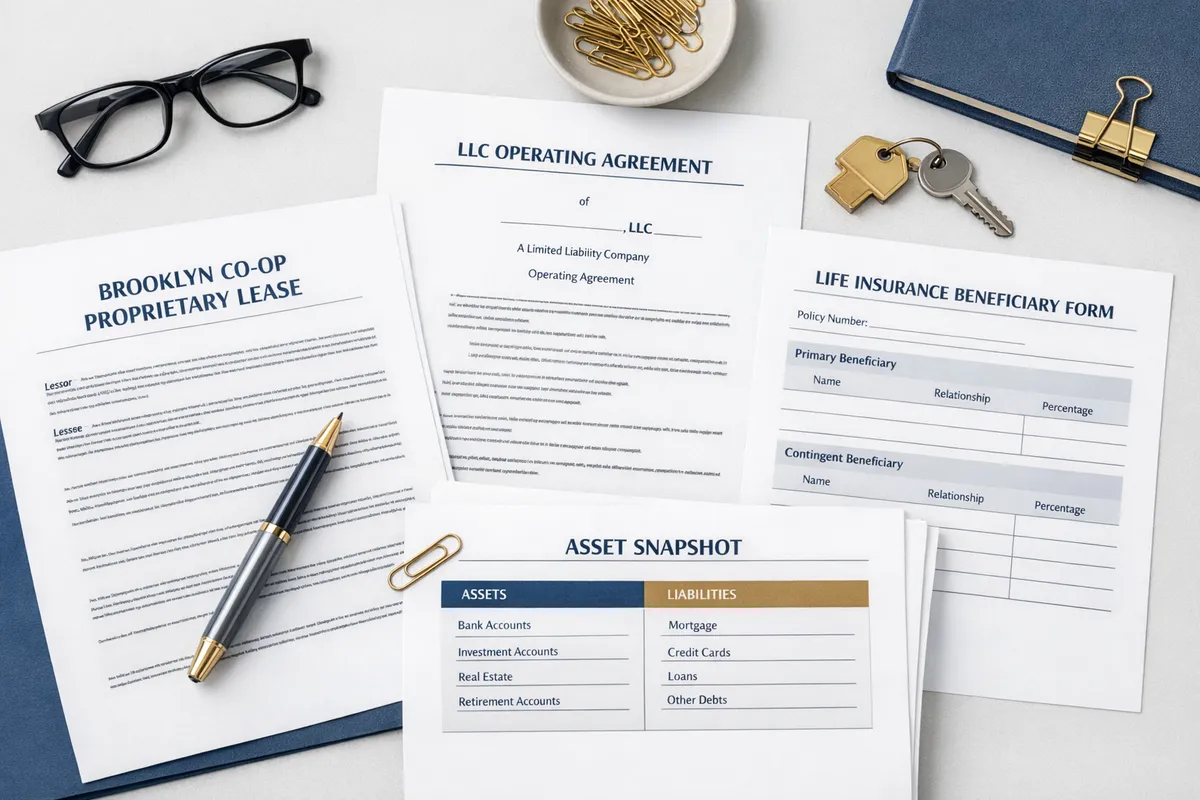
A quick but important point: people sometimes “gift” a home to children to avoid probate. That can create tax issues by losing the step-up in basis. The IRS explains basis rules in Publication 551. If you are considering transferring a primary residence, review our Brooklyn-focused discussion on whether you should put your home in an irrevocable trust.
Now that you know what to gather, the next section turns that into an estate planning checklist for beginners you can actually use.
Estate Planning Checklist for Beginners: Workshop Insights and Practical Tips
An estate planning checklist for beginners works best when it mirrors how plans are built in real meetings. In our workshops, we see that people make progress when the checklist is short, sequenced, and tied to a real outcome, not busywork.
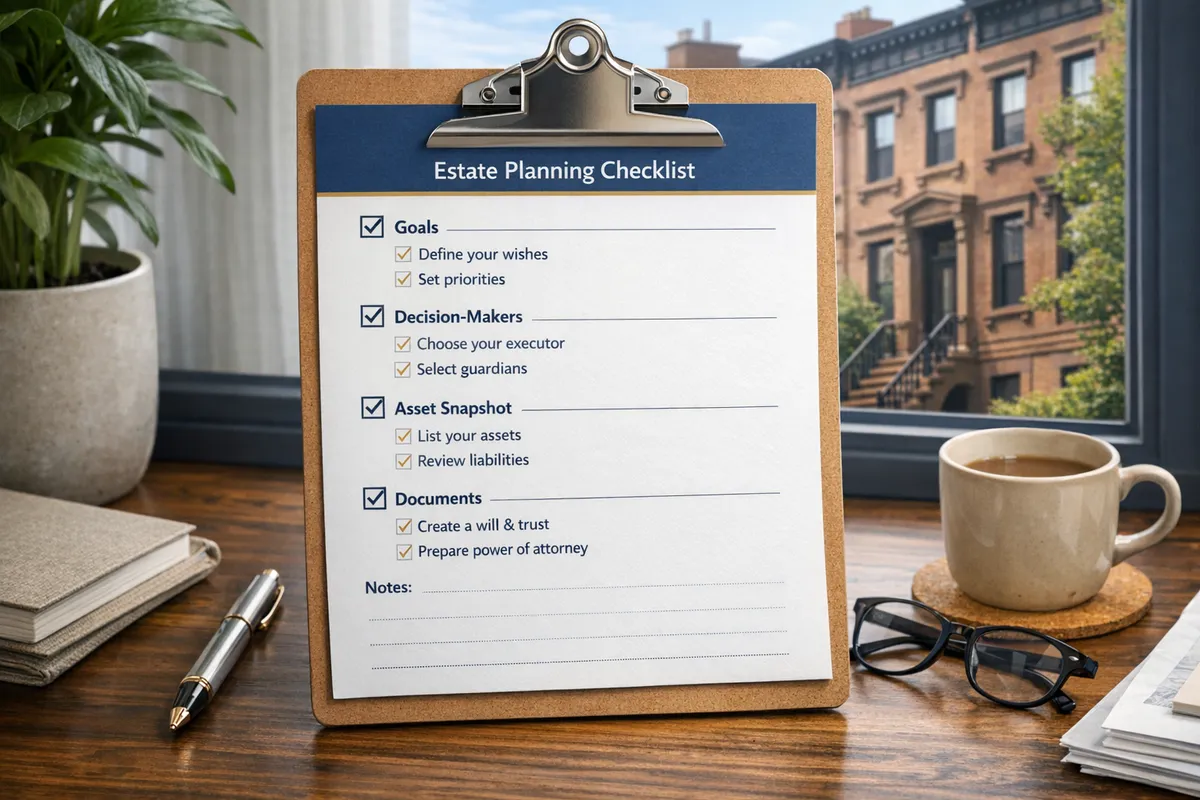
The “first meeting ready” checklist
Use this as your practical first step in estate planning process prep. Aim to complete it in one to two sittings.
- Write down your top priorities: “Avoid probate,” “protect the business,” “plan for long-term care,” or “keep things fair between kids.”
- List decision-makers: who would serve as agent, executor, trustee, and guardian, plus one backup for each.
- Make an asset snapshot: real estate, retirement, banking, life insurance, and business ownership.
- Identify any special circumstances: divorce, blended family, a beneficiary with disabilities, immigration issues, or creditor concerns.
- Collect key documents: deeds, co-op papers, account statements, business agreements.
If you struggle with the asset snapshot, you are not alone. We see this constantly, especially with multiple accounts or a side business. Our post on keeping financial information up to date explains why accuracy matters and how to organize it without spending weeks.
Practical workshop tip: do not skip “personal property” planning
One of the fastest ways families end up fighting is not over the house, it is over the “stuff.” Jewelry, photos, religious items, family recipes, and collections carry emotion. If you have meaningful personal possessions, read Memory Makers: Your Personal Possessions and consider creating a simple written list to guide your executor.
This checklist sets you up to draft documents smoothly. Next, let’s talk about estate planning tips for Brooklyn families, including common pitfalls we see right at the first step.
Estate Planning Tips for Brooklyn Families: Avoiding Common Pitfalls in the First Step
The biggest mistake we see is confusing “doing something” with doing the right first step in estate planning. A form downloaded online feels productive, but it can miss New York-specific requirements, conflict with beneficiary designations, or ignore a co-op’s transfer rules.
Pitfall 1: Starting with the wrong tool (especially trusts)
Trusts are powerful, but they are not universal. For some young professionals in Downtown Brooklyn, a will plus solid powers of attorney is the right first step. For a caregiver worried about nursing home costs, elder law planning might be the priority. If you are unsure what an elder law attorney actually does in these situations, see What Can an Elder Law Attorney do For You?.
Pitfall 2: Forgetting the “funding” side of planning
Even a well-drafted trust does not avoid probate if nothing is transferred into it. In our experience, the first step in the estate planning process must include a plan for aligning titles and beneficiaries. This is where business owners often miss critical items like business bank accounts, merchant services, or a lease that is in the wrong name.
Pitfall 3: Not planning for life changes
Divorce, remarriage, or a new child can turn an old plan into a problem. For divorcing parents, the “first step” often includes reviewing who is named on retirement accounts and life insurance, not just drafting new documents. If your family structure is complex or you want planning that reflects identity and chosen family, our resource on estate planning for the LGBTQ+ community may be helpful.

Pitfall 4: Believing banks always release funds without probate
Families are often surprised when an account is frozen after death. Whether probate is required depends on how the account is titled and whether there is a named beneficiary. That is why the first step in estate planning is gathering account details and confirming beneficiaries.
Want a plan that fits your family and your assets, without guesswork? Schedule a Free Consultation with Alatsas Law Firm.
Frequently Asked Questions About the First Step in Estate Planning
Do banks require probate to release funds?
Sometimes yes, but many bank and investment accounts can transfer without probate if they are set up correctly. Joint accounts with rights of survivorship, payable-on-death (POD) accounts, and accounts with named beneficiaries often pass outside probate. If the account is only in the deceased person’s name with no beneficiary, the bank may require court authority. This is why what is the first step in estate planning often includes reviewing account titles and beneficiary designations.
What is the 5 by 5 rule in estate planning?
The 5 by 5 rule is a common trust provision that limits withdrawals to the greater of $5,000 or 5% of trust assets in a given year. It is often used in certain irrevocable trust designs to balance access with tax and creditor-protection goals. Not every family needs it, and it is not a “starter” concept for most beginners. If you are exploring trusts, start with your goals first, then match provisions to the purpose.
Is estate planning only for wealthy families?
No, estate planning is often most valuable for middle-income families because it prevents expensive court problems and confusion. If you own a home, have children, run a small business, or care for an aging parent, the right first step can protect your family’s time, privacy, and financial stability. For Medicaid-related planning, New York’s official Medicaid information is a good starting point: New York State Department of Health Medicaid.
Your Next Steps in Brooklyn Estate Planning
What is the first step in estate planning? It is getting your goals, decision-makers, and asset snapshot on paper so your documents are built on facts, not assumptions. Once you take that step, everything else becomes clearer, whether you need a will-based plan, trust planning, or elder law strategies.
If you are in Brooklyn and you want a plan that respects your family dynamics, your business realities, and New York law, the next move is straightforward. Start small, start organized, and start with the right sequence. When you are ready, our team at Alatsas Law Firm can guide you through the same workshop-based process we use with families across neighborhoods from Sheepshead Bay to Bushwick.