
Probate and estate attorneys help families settle a loved one's affairs correctly, with less delay and fewer costly mistakes. They guide executors through court filings, asset inventories, creditor claims, taxes, and the transfer of property to heirs. Estate planning attorneys also help people plan ahead with wills, trusts, and beneficiary designations that may reduce what must go through probate.
Probate is the court-supervised process of validating a will, paying valid debts and taxes, and distributing remaining assets. A will can state who should inherit, but it does not by itself keep an estate out of probate. When there is real estate, family conflict, missing documents, creditor issues, or assets in more than one state, experienced legal guidance can protect both the executor and the family.
I am Theodore Alatsas, an attorney with more than 30 years of experience serving Brooklyn families with estate planning, elder law, asset protection, and probate matters. As one of the local probate and estate attorneys families turn to for clear guidance, I help clients protect their home and savings while navigating estate settlement with care.
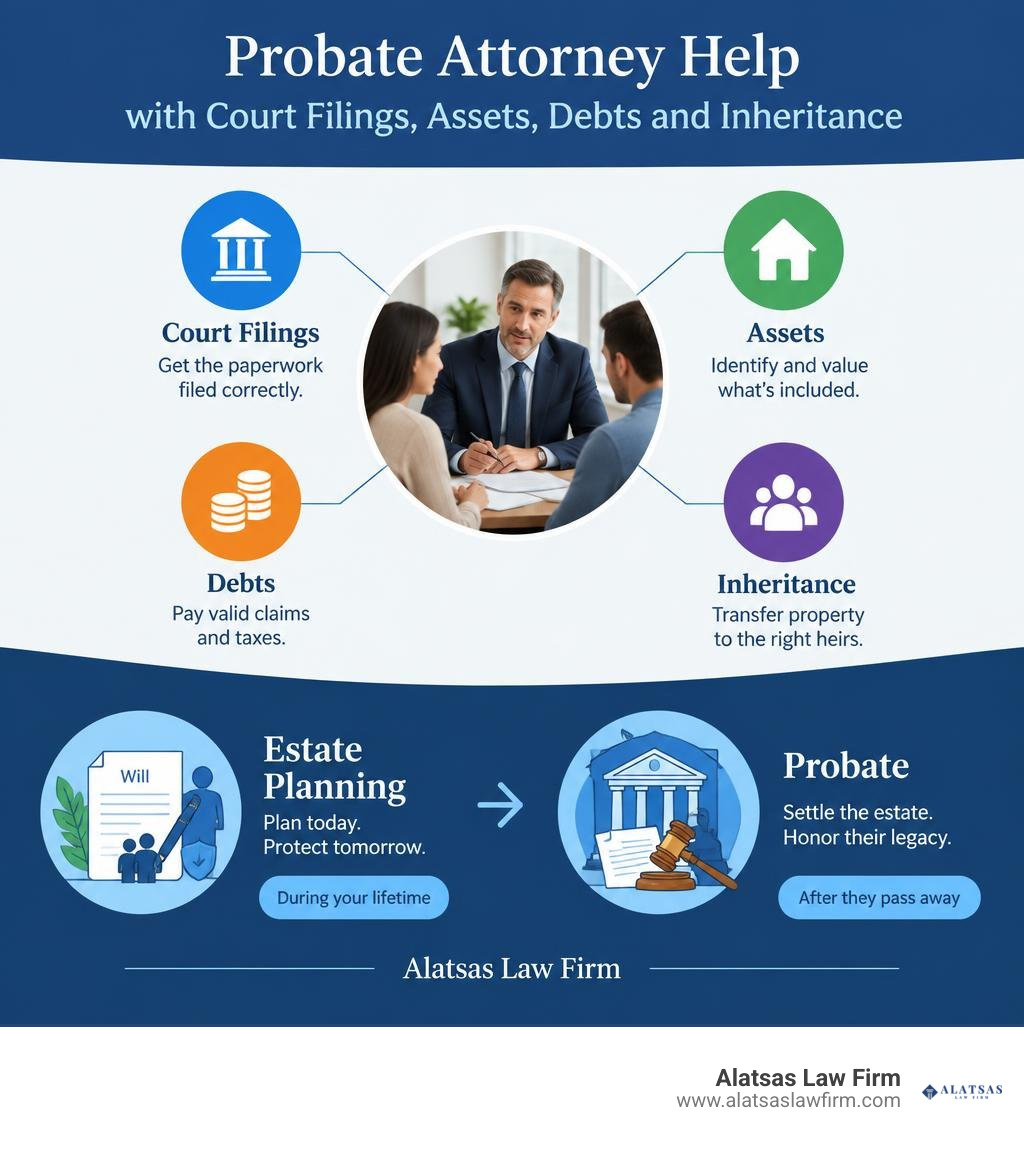
People often use the terms "estate planning" and "probate" interchangeably, but they represent two distinct phases of property and legacy management.
Estate planning happens during your lifetime. You work with an attorney to design a roadmap for your future, safeguard your wealth, select trusted decision-makers, and ensure your loved ones are provided for. Probate, on the other hand, is the post-mortem legal administration that begins after someone passes away. It involves bringing that roadmap—or the state's default rules if no roadmap exists—before a judge to formally wrap up financial affairs.
| Feature | Estate Planning | Probate Administration |
|---|---|---|
| Timing | Proactive (during the client's life) | Reactive (after the individual passes away) |
| Primary Goal | Asset protection, tax reduction, legacy design | Will validation, debt payoff, asset distribution |
| Key Documents | Wills, Revocable Living Trusts, Powers of Attorney, Health Care Proxies | Petitions for Probate, Letters Testamentary, Formal Accountings |
| Court Involvement | Typically none; documents are drafted privately | Mandatory supervision by the local probate or Surrogate's Court |
| Privacy | Kept private within the family and legal team | Becomes a matter of public court record |
When individuals fail to establish a comprehensive plan while living, their families often face severe statutory roadblocks. Exploring the problems with failing to have an estate plan reveals how quickly state intestacy laws can divide property contrary to a decedent's real wishes, creating unnecessary court delays and inflating legal costs.
Understanding the Core Roles of Probate and Estate Attorneys
During estate administration, legal responsibilities must remain distinct. A frequent source of confusion is understanding who does the probate attorney represent?
In an estate settlement proceeding, the probate lawyer represents the estate's personal representative (the executor named in a will or the administrator appointed by the court), not the beneficiaries. While the attorney works to fulfill the terms of the estate, their direct client is the fiduciary.
The attorney ensures the executor upholds their strict fiduciary duties, complies with court deadlines, settles debts correctly, and avoids personal legal liability. Beneficiaries have rights to transparent accountings and timely distributions, but they can hire their own counsel if conflicts or concerns arise. For a broader overview of the legal framework, see probate on Wikipedia.
How Probate and Estate Attorneys Navigate the Court Process
Navigating court proceedings requires careful attention to statutory timelines and local procedural rules.
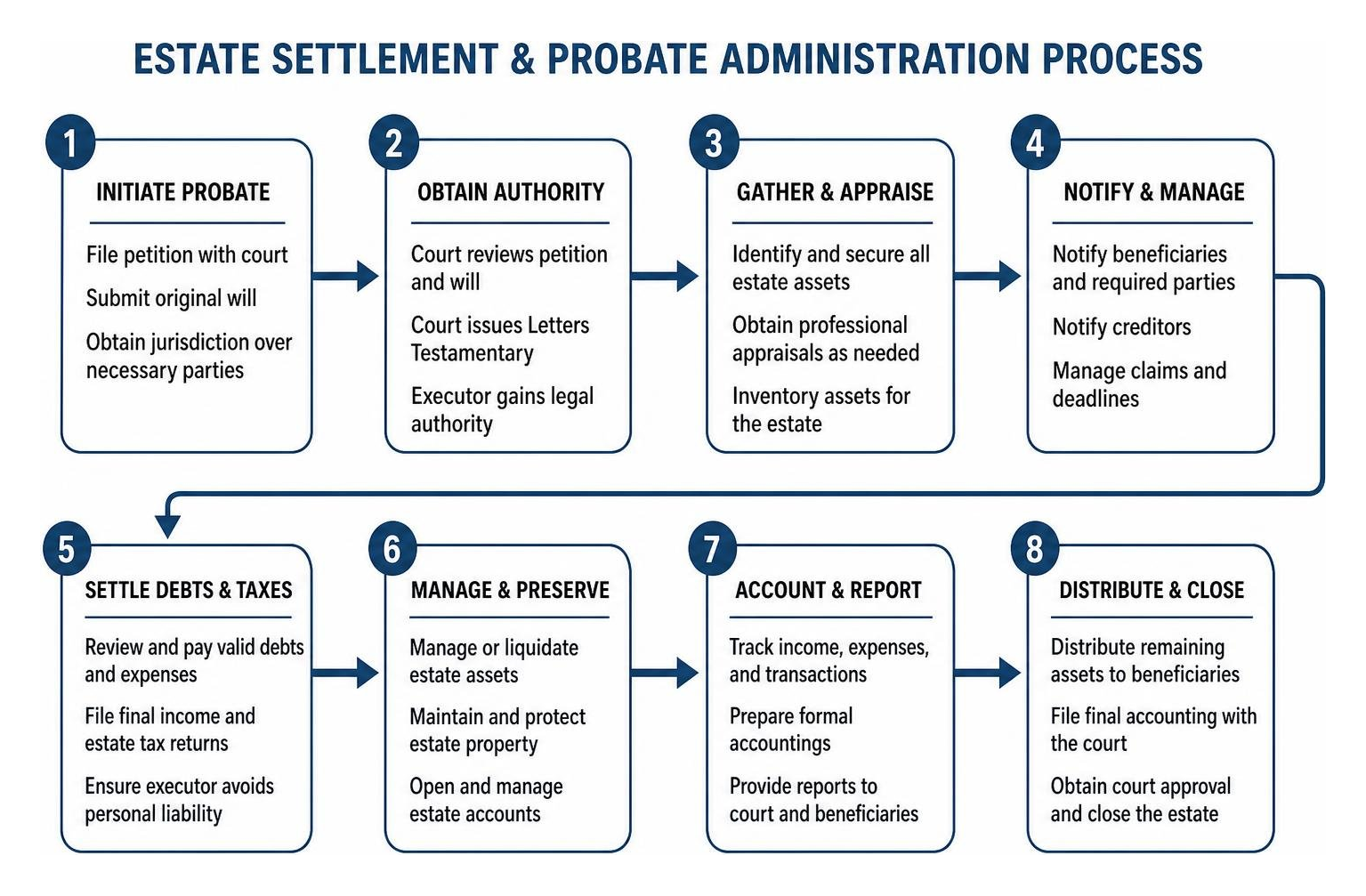
When initiating probate, attorneys draft and file the formal petition with the court, submit the original will, and obtain jurisdiction over all necessary parties. Understanding the broader picture by explaining the probate process helps families realize that petition filing is just step one.
Once the court grants authority, the legal team assists in gathering assets, obtaining professional real estate and property appraisals, and notifying creditors. Managing debts requires precision; dealing with probate disruption by creditors ensures valid debts are settled without leaving the executor personally on the hook or paying fraudulent claims. The attorney also coordinates final income and estate tax filings before closing the estate.
Key Responsibilities and Duties of the Executor
Serving as an executor is an honor, but it carries substantial legal responsibility. Reviewing what does the executor of an estate do? shows that the fiduciary is tasked with locating all testamentary documents, opening dedicated estate bank accounts, liquidating or preserving property, and managing family communications.
Following a guide to settling an estate enables personal representatives to track expenses, secure property (such as changing locks on vacant homes), and prepare detailed accountings before distributing a single dollar to beneficiaries.
Navigating Local Surrogate and Probate Courts
Every jurisdiction possesses distinct local rules, customs, and filing practices. In New York, for instance, probate matters are handled by the Surrogate's Court in the county where the deceased resided.
Having Brooklyn probate court explained by experienced counsel ensures that petitions satisfy local requirements, reducing administrative rejections and expediting the issuance of Letters Testamentary.
Managing Legal Costs and Exploring Flexible Representation
Legal fees during probate typically follow one of three structures:
- Hourly Billing: The attorney tracks time spent on filings, hearings, asset transfers, and correspondence. This is the most common approach across the legal industry.
- Flat Fees: A predictable, fixed sum agreed upon upfront for straightforward, uncontested estates.
- Percentage of Estate: Fees calculated as a specific percentage of the total estate value, permitted in certain jurisdictions under statutory guidelines.
Importantly, probate attorney fees are recognized as administrative expenses. This means they are paid directly out of the estate’s assets—not out of the executor's or heirs' personal pockets—before final distributions are distributed to beneficiaries.
Utilizing Unbundled Legal Services for Estate Administration
For families managing a straightforward estate on a limited budget, unbundled legal services—also known as limited-scope representation—offer a flexible alternative. Instead of retaining a lawyer for full-service representation from start to finish, you hire counsel for specific tasks.
These tasks may include reviewing court petitions, drafting formal waivers, resolving a tricky title issue on real property, or coaching the executor through court accounting procedures. Unbundled support ensures critical documents are legally sound while keeping overall administrative costs manageable.
Determining When You Need Legal Representation for an Estate
While small, uncomplicated estates can occasionally be settled independently, many circumstances demand skilled legal intervention.

Hiring an attorney becomes vital when an estate includes:
- Complex real estate holdings, commercial properties, or out-of-state assets
- Closely held family businesses requiring uninterrupted continuity
- Potential insolvency (where debts exceed the value of assets)
- Disgruntled family members threatening will contests or claiming undue influence
- Missing heirs or unclear language in testamentary documents
Reviewing notorious probate horror stories to avoid in New York demonstrates how self-administration errors can lead to personal lawsuits, tax penalties, and years of frozen inheritance assets.
Self-Assessment Checklist Before Initiating Probate
Ask yourself these foundational questions before deciding to proceed without counsel:
- Is the estate fully solvent, with cash easily available to satisfy all known debts?
- Are all heirs and beneficiaries in total agreement, willing to sign waivers and consents?
- Do you have the original, pristine Will (without missing staples or handwritten marks)?
- Are you prepared to personally calculate and defend formal estate accountings?
- Do you understand the specific tax returns (Form 1040, Form 1041, Form 706) required by state and federal taxing authorities?
If the answer to any of these questions is "no" or "uncertain," seeking legal guidance is advisable.
Strategies for Avoiding Probate in Future Planning
The most effective way to eliminate probate stress for your loved ones is to bypass the court process entirely through proactive estate planning. By learning avoiding probate in New York Brooklyn estate planning tips, you can implement tools such as:
- Revocable Living Trusts: Holding your home and investments inside a trust allows assets to transfer immediately to designated beneficiaries upon death without court involvement or public records.
- Pour-Over Wills: Serving as a safety net to sweep any forgotten assets into your living trust.
- Beneficiary Designations: Setting up Transfer-on-Death (TOD) or Paid-on-Death (POD) designations on retirement accounts, life insurance, and bank accounts.
- Joint Ownership Structures: Utilizing survivorship deeds for primary residences where suitable.
Finding the Right Legal Partner for Estate Settlement
When choosing legal counsel, personal recommendations, state bar member directories, and peer ratings offer reliable starting points. For a deeper breakdown of the profession, read our resource on what is a probate lawyer and why do you need one?.
How to Select Qualified Probate and Estate Attorneys
To find an attorney well-suited to your needs, assess the following during your initial consultation:
- Specific Practice Focus: Does the lawyer concentrate daily on probate, trusts, elder law, and estate administration, or do they treat it as an occasional side practice?
- Familiarity with Local Courts: Do they regularly interact with your county’s Surrogate's or Probate Court clerks and judges?
- Communication Style: Do they explain complex legal concepts in plain, compassionate language?
- Fee Transparency: Are their fee structures, retainer requirements, and billing rates clearly spelled out in a written engagement agreement?
Preparing Essential Documents for Your Initial Consultation
To maximize the value of your first meeting, gather and organize the following records:
- The original Last Will and Testament (along with any codicils)
- Multiple certified copies of the death certificate
- Deeds for all real estate properties
- Recent bank, brokerage, and retirement account statements
- Vehicle, boat, and mobile home titles
- Life insurance policy documentation
- Any outstanding debt notices, mortgage statements, tax bills, and medical claims
Frequently Asked Questions About Estate Settlement and Probate
Can an executor settle an estate without hiring a lawyer?
Yes, in simple cases where an individual is the sole beneficiary and no complex assets or debts exist, they may file pro se. However, in many jurisdictions, courts restrict non-lawyers from representing an estate pro se if there are other beneficiaries or creditors involved, as doing so constitutes the unauthorized practice of law on behalf of others. Furthermore, executors remain personally liable for administrative missteps.
Who pays for the probate lawyer fees during estate administration?
Attorney fees are paid directly from the estate's funds. They are classified as administrative expenses, giving them legal priority over general creditor claims and beneficiary distributions. The executor does not pay these fees out of their own personal wages unless they mismanage the estate.
How long does the probate process usually take from start to finish?
An uncontested, relatively straightforward probate matter typically takes between 7 to 12 months. This timeframe accommodates mandatory statutory notice windows for creditors (which often run several months), court scheduling, asset liquidation, and tax filings. Contested estates or those involving hard-to-value assets can take several years.
Conclusion
Managing an estate while grieving a loss can feel overwhelming, but you do not have to carry the legal burdens alone. Proper legal representation safeguards executors against personal liability, protects family relationships, and ensures assets are distributed according to your loved one’s true wishes.
At Alatsas Law Firm, our three-pillar protection framework and community-focused approach help New York families navigate estate administration with confidence and peace of mind. To learn more about how we can help your family through every stage of administration, explore our guide on navigating the New York probate process from start to finish or contact our office today to schedule your consultation.