When a loved one passes in Brooklyn, it can feel like estate matters suddenly become overwhelming. For many middle-income families, worries about court delays, costly disputes, and protecting family assets add new stress during an already difficult time. Understanding the true role of the probate court—and the difference between routine cases and genuine complications—can make all the difference. This guide breaks down the facts and busts common myths so you can safeguard your family’s future with clarity and confidence.
Key Takeaways
| Point | Details |
|---|---|
| Understanding the Probate Process | The probate court in Brooklyn handles the validation of wills, appointment of executors, and distribution of assets, often following a straightforward path unless complications arise. |
| Myths About Probate | Common misconceptions suggest that probate is always lengthy and contentious; however, many cases are routine and administrative with minimal conflict. |
| Document Organization is Crucial | Properly documenting and organizing estate assets and debts can significantly expedite the probate process and reduce costs. |
| Legal Formalities Must Be Followed | Adhering to New York’s legal requirements for notifications, filings, and documentation is essential to avoid delays and complications during probate. |
Probate Court’s Role and Common Misconceptions
When someone passes away in Brooklyn, their estate does not simply transfer to heirs overnight. A probate court is a court of limited jurisdiction that handles the legal process of settling what they left behind. The probate court’s primary job is straightforward: validate the will, supervise the appointment of an executor or administrator, ensure assets get distributed according to the person’s wishes or New York state law if no will exists, and resolve any disputes that arise among family members or beneficiaries. For families in Brooklyn dealing with estates of any size, understanding exactly what the probate court does can eliminate unnecessary worry and help you prepare for what comes next. The court operates under New York law with specific procedures and timelines, though many cases move through without major complications.
Here’s what often trips people up: most folks believe probate is always a lengthy, contentious battle that drains estates and creates family warfare. The truth is more nuanced. Many probate cases are routine and administrative, meaning they follow a predictable path with minimal conflict. Your situation depends on several factors, including whether you have a clear, valid will, the estate’s complexity, family relationships, and whether beneficiaries agree on how things should be handled. When a will appears straightforward and everyone involved cooperates, the probate court simply validates the document and oversees the transfer of assets. Disputes do happen, certainly, but they are not the default outcome. Understanding what an executor does during probate administration helps clarify how much court involvement is actually necessary in most Brooklyn estates.
Another major misconception involves the court’s actual powers and limitations. People often think probate court can settle ownership disputes or decide who deserves what based on family circumstances. In reality, the court’s role is much narrower. It authenticates wills, grants authority to executors or administrators, ensures proper asset distribution according to legal requirements, and handles disputes specifically related to how the estate should be managed or distributed. The court does not make decisions about which family member deserves more money based on emotional circumstances, nor does it settle property ownership questions that fall outside the estate inventory. This distinction matters because it shapes what you can realistically expect the court to accomplish. Knowing these boundaries helps families avoid wasting time and money pursuing court intervention for matters the court simply cannot address. The probate process itself can feel mysterious, but the court’s responsibilities are defined and limited in specific ways.
Pro tip: Before assuming your estate will face probate complications, meet with a probate attorney in Brooklyn who can review your specific situation and clarify whether your case is likely to be routine or whether complications may arise.
Types of Probate Matters Handled
The probate court in Brooklyn handles a wide range of matters related to settling someone’s estate after death. At the most basic level, probate courts validate wills and appoint executors to manage the estate. But that is just the beginning. Once a will is validated, the executor’s work involves inventorying all estate assets, collecting them, paying off debts and taxes, and ultimately distributing what remains to the rightful beneficiaries. This process can take anywhere from several months to over a year depending on the estate’s complexity and whether disputes arise. The probate court oversees each step, ensuring the executor follows New York law and acts in the beneficiaries’ best interests. For families dealing with a loved one’s passing, knowing what the court actually handles helps set realistic expectations about timing and what you can expect from the probate process.
Not all estates require the same level of court involvement. Testate estates (those with a valid will) generally follow a straightforward path where the court validates the will and monitors the executor’s administration. Intestate estates (those without a will) require the court to appoint an administrator who then follows New York’s intestacy laws to determine who inherits what. The court also handles disputes among heirs or creditors who believe they have claims against the estate. These conflicts might involve questions about the validity of the will itself, disagreements over asset distribution, or creditor claims that need verification. Additionally, the probate court manages small estates through a simplified process when the estate’s total value falls below certain thresholds, which can save families considerable time and expense. For estates with property or assets located outside New York State, the court may oversee ancillary estate proceedings to handle those out-of-state assets separately. Each type of matter carries different requirements and timelines.
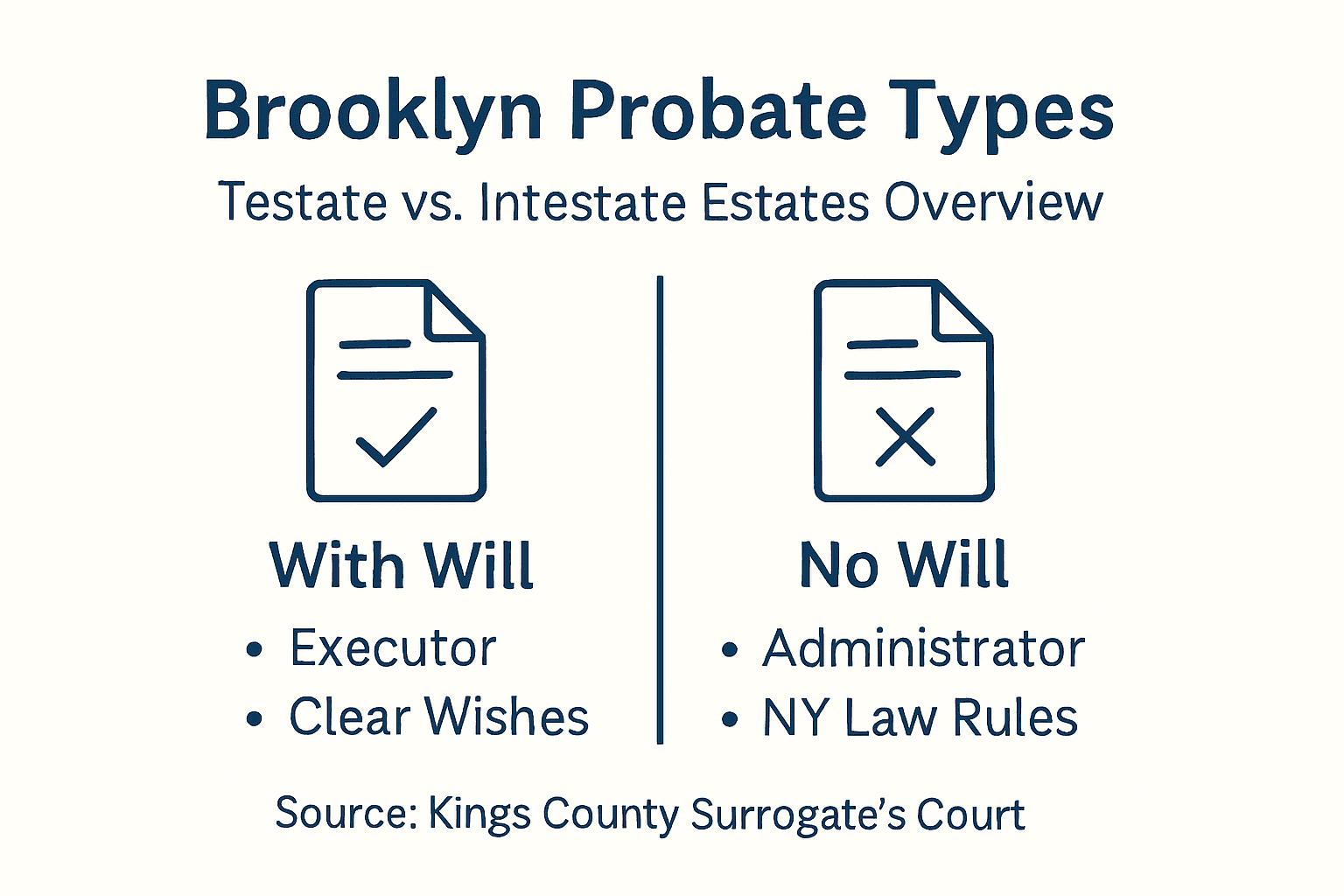
Here’s a comparison of testate and intestate estate procedures in Brooklyn:
| Aspect | Testate Estate (With Will) | Intestate Estate (No Will) |
|---|---|---|
| Court Appointment | Executor named in will | Administrator appointed by court |
| Asset Distribution | Follows will instructions | Follows New York intestacy laws |
| Family Disputes | Less likely if will is clear | More likely due to unclear wishes |
| Process Complexity | Usually more streamlined | Can be more complex and time-consuming |
| Court Oversight | Validates will, limited intervention | Oversees asset division and heirs |
Beyond the standard matters, probate courts in Brooklyn also address tax-related issues within the estate administration. The court ensures that estate and inheritance taxes are calculated correctly and paid before distributions are made to beneficiaries. In some cases, the executor may need court approval for certain decisions, particularly if beneficiaries object or if the will is unclear on specific points. The court can also resolve disputes between the executor and beneficiaries, such as questions about whether the executor is acting appropriately or charges it is taking are reasonable. Additionally, depending on the situation, probate courts handle related guardianship or conservatorship matters if the deceased left behind minor children or dependents without clear arrangements. The key thing to understand is that the probate court’s role is to ensure orderly transfer of property and address all creditor claims before beneficiaries receive their inheritance. This protective function exists to shield beneficiaries from liability and ensure debts are satisfied in the proper order.
Pro tip: Document your estate’s assets, debts, and wishes now so your executor and the probate court have clear guidance; estates with organized records move through probate significantly faster than those requiring the executor to hunt down financial information.
Brooklyn Probate Process Step by Step
The probate process in Brooklyn follows a structured sequence that begins the moment you decide to move forward with settling an estate. Your first real task involves gathering critical documents: the original will (if one exists), the deceased person’s certified death certificate, and a comprehensive list of all assets, debts, and beneficiaries. These items form the foundation for everything that follows. Once assembled, you file a Petition for Probate with the Surrogate’s Court in Kings County (Brooklyn’s probate court). This petition formally asks the court to validate the will and appoint an executor or administrator to manage the estate. The petition must include specific information about the deceased, the proposed executor, and a description of the estate’s approximate value. Filing fees apply based on the estate’s size, and the court processes your petition over the following weeks. When the court approves your petition, it issues either Letters Testamentary (if there is a valid will) or Letters of Administration (if there is no will), officially granting the executor or administrator legal authority to act on the estate’s behalf.
After receiving your letters from the court, the real administrative work begins. The executor or administrator must notify all heirs, beneficiaries, and creditors of the estate’s opening and their rights within the process. This notification serves a crucial legal purpose: it starts a deadline clock for creditors to submit claims against the estate. The representative then inventories all estate assets, which might include real estate, bank accounts, investments, vehicles, and personal property. This inventory gets submitted to the court and forms the official record of what the estate contains. Simultaneously, the executor collects assets where possible, notifies financial institutions of the death, and begins paying outstanding debts. If the estate owes income taxes, estate taxes, or property taxes, the executor must file appropriate tax returns and pay what is owed before any distributions can be made to beneficiaries. This step protects beneficiaries from personal liability for unpaid taxes. Throughout this phase, the executor maintains detailed records of all transactions, expenses, and distributions.

The final phase involves distributing remaining assets to beneficiaries according to the will’s terms or New York’s intestacy laws if no will exists. Before distributions occur, the executor must obtain court approval of the estate accounting, which itemizes all money received, spent, and held. Beneficiaries receive written notice of the proposed distributions and have an opportunity to object if they believe something is improper. Once the court approves the accounting, the executor distributes the remaining estate property. The entire process typically takes six months to over a year, depending on the estate’s complexity, whether disputes arise, and how quickly documents are gathered. For estates under $50,000, Brooklyn offers a simplified small estate procedure that bypasses much of this formal process, saving time and expense for families with smaller estates. Understanding each step helps families prepare mentally and financially for what lies ahead.
Pro tip: Start gathering documents immediately after death, including the original will, death certificates, bank statements, and property deeds; having these ready before meeting with a probate attorney accelerates the filing process and reduces overall costs.
Legal Requirements and Formalities Explained
Probate in Brooklyn involves specific legal requirements and formalities that exist to protect beneficiaries, creditors, and the integrity of the process itself. At the foundation, a will must meet strict execution and testamentary capacity requirements to be admitted to probate. This means the person who created the will must have been of sound mind, acted without coercion, and signed it with proper witnesses (typically two disinterested witnesses in New York). The will must also be the original document or a certified copy, not a photocopy. When you file your petition with the Surrogate’s Court, the petition for probate requires specific forms and documents, including a certified death certificate and the original will if available. The court uses these documents to verify that the will meets legal standards and that the person requesting to be executor or administrator is qualified for the role. This validation step protects everyone involved by ensuring that only legitimate wills are honored and that only responsible people manage estates.
Once the court accepts your petition, legal formalities require you to notify interested parties of the probate proceeding. This means publishing legal notices in newspapers, mailing notices to all known heirs and beneficiaries, and informing creditors of the estate’s opening. These notice requirements exist because estate administration is a matter of public record, and people with potential claims or interests deserve to know what is happening. Creditors have a specific window of time, typically several months depending on the type of notice given, to submit claims against the estate. If a creditor fails to file within this window, their claim is generally barred, which protects the estate and beneficiaries from surprise claims years later. The executor or administrator must maintain documentation proving that all notices were sent, as the court will want evidence of compliance. Additionally, New York law requires the executor to submit an inventory of estate assets to the court within a specified timeframe. This inventory details everything the estate owns, along with estimated values, and serves as the official record of the estate’s contents. Failure to file required documents or notices on time can result in court sanctions, delays, or removal of the executor, which is why strict adherence to deadlines matters significantly.
The legal framework governing estate administration comes from the Estates, Powers and Trusts Law (EPTL), the primary statute controlling how estates are managed in New York. The EPTL specifies executor duties, beneficiary rights, tax obligations, and the order in which debts must be paid. For example, administration expenses and funeral costs have priority, followed by debts to the state and federal government, then creditor claims, and finally distributions to beneficiaries. Filing deadlines and court compliance requirements protect the estate and prevent penalties or unnecessary delays. If the estate becomes contested, formal administration procedures apply, which involve more court oversight and opportunity for interested parties to raise objections. If everyone agrees on the will’s validity and distribution, informal procedures may allow for faster resolution. Understanding these legal formalities helps Brooklyn families appreciate why their executor or administrator might request certain documents or need time to complete tasks. The formalities exist not to create obstacles but to ensure fairness and protect everyone’s interests. Families should work with an experienced probate attorney to navigate these requirements accurately and avoid costly mistakes that could delay distributions or create legal exposure.
Pro tip: Ensure the original will is properly stored and accessible immediately after death, as courts require certified copies or originals; digital photos or scans are not acceptable for filing purposes.
Risks, Costs, and How to Avoid Delays
Probate in Brooklyn carries real financial costs that can surprise families unprepared for them. Court filing fees, executor compensation, attorney fees, appraisal expenses, and publication notices all add up quickly. On average, probate costs range from 3% to 7% of the estate’s gross value, meaning a $500,000 estate could easily cost between $15,000 and $35,000 in combined expenses before beneficiaries receive a single dollar. These costs exist whether the estate moves smoothly or encounters complications. For middle-income Brooklyn families, this financial reality demands careful planning and strategic decision-making. Some costs cannot be avoided, but others can be minimized through proper preparation and professional guidance. Understanding where money goes helps you make informed choices about how to proceed with your specific situation.
Beyond costs, probate carries several risks that can extend timelines and create family stress. Will contests happen when beneficiaries or other interested parties challenge the will’s validity, claiming the deceased was not of sound mind or was unduly influenced. Disputes among heirs emerge when family members disagree about how assets should be distributed or whether the executor is acting appropriately. Creditor claims can surface months or even years after death, requiring the estate to pay debts that might consume significant assets. Administrative errors such as missed deadlines, incomplete inventories, or improper notice can force the court to delay probate proceedings or require corrective filings that cost additional time and money. Missing documents create particular headaches; if the original will cannot be located, the court may declare the person died intestate, changing how assets are distributed. Complex assets like businesses, rental properties, or investments require appraisals and specialized management, extending the timeline significantly. Court backlogs in Brooklyn also contribute to delays, sometimes adding months to the process even when everything else proceeds smoothly. Families cannot eliminate all risks, but they can substantially reduce them through preparation.
The most effective strategy for avoiding delays begins before probate even starts. Organize financial documents now, including bank statements, investment accounts, property deeds, and insurance policies. Keep your will in a safe but accessible location, and communicate with your family about where it can be found when needed. Consider using beneficiary designations on retirement accounts and life insurance policies, which bypass probate entirely and transfer directly to named beneficiaries. Explore living trusts as an alternative to traditional wills; assets held in a living trust avoid probate altogether, providing faster distribution and greater privacy. For smaller estates, small estate affidavits allow for simplified procedures that eliminate formal probate entirely if the estate’s value falls below statutory thresholds. Once probate begins, delays decrease significantly when the executor files all required documents promptly, maintains meticulous records, and communicates regularly with beneficiaries. Working with an experienced probate attorney from the start prevents costly mistakes and ensures compliance with New York’s specific procedural requirements. Many families believe they can manage probate without legal help, but the money saved by avoiding attorney fees often pales in comparison to expenses incurred by administrative errors or disputes that could have been prevented.
Summary of common probate delays and strategies to minimize them:
| Common Delay | Typical Cause | Prevention Strategy |
|---|---|---|
| Document delays | Missing or incomplete paperwork | Prepare all essential documents upfront |
| Disputed assets | Inaccurate or contested valuations | Obtain independent appraisals early |
| Will contests | Questions over validity or intent | Ensure clear, witnessed will execution |
| Creditor claims | Overlooked debts or claims | Notify creditors and settle debts promptly |
| Court backlog | High case volume | File promptly and follow up regularly |
Common Delay Triggers and Prevention
- Missing or unclear documentation — Gather and organize all financial records immediately after death
- Failure to notify interested parties timely — Submit all required legal notices within statutory deadlines
- Unresolved tax obligations — File all necessary tax returns and pay what is owed before distributions
- Disputed asset values — Obtain professional appraisals early to prevent beneficiary disagreements
- Executor incapacity or unwillingness — Verify the executor can actually perform the role before court appointment
- Contested wills — Ensure the will meets all execution requirements and document the testator’s capacity
Pro tip: Act quickly after death by hiring a probate attorney within the first few weeks; early intervention prevents costly mistakes and positions the estate for faster resolution, ultimately saving money despite upfront legal costs.
Navigate Brooklyn Probate with Confidence and Expert Legal Support
Dealing with the probate court process in Brooklyn can feel overwhelming and stressful for families facing estate matters. Common challenges like lengthy delays, complex legal requirements, and potential disputes often cause confusion and emotional strain. If you want to avoid unnecessary complications, safeguard your loved ones’ inheritance, and understand the probate steps clearly, having trusted legal guidance is essential. Our experienced team at Alatsas Law Firm understands the unique nuances of New York probate law and focuses on helping Brooklyn families move smoothly through every phase, from validating wills to final asset distribution.
Do not wait until probate complications arise. By acting now and consulting a knowledgeable probate attorney, you can reduce risks, prevent costly delays, and ensure all legal formalities are properly handled. Discover more about what an executor does during estate administration in Brooklyn, understand ancillary estate proceedings, and learn how to prepare for probate with confidence. Reach out today to get personalized assistance tailored to your family’s situation. Contact us directly at Alatsas Law Firm to schedule your consultation and take the first important step toward resolving your estate matters with peace of mind.
Frequently Asked Questions
What is the primary role of probate court in Brooklyn?
The primary role of probate court in Brooklyn is to validate wills, supervise the appointment of executors or administrators, ensure assets are distributed according to the deceased’s wishes or state law, and resolve any disputes that may arise among heirs or beneficiaries.
How long does the probate process usually take in Brooklyn?
The probate process in Brooklyn typically takes between six months to over a year, depending on the estate’s complexity, whether disputes arise, and how quickly necessary documents are gathered.
What are the costs associated with probate proceedings?
Probate costs can range from 3% to 7% of the estate’s gross value, which may include court filing fees, executor compensation, attorney fees, publication expenses, and appraisal costs.
What should I do if there is no will for the estate?
If there is no will, the probate court will appoint an administrator to manage the estate according to New York’s intestacy laws, which dictate how assets will be distributed among the deceased’s heirs.