
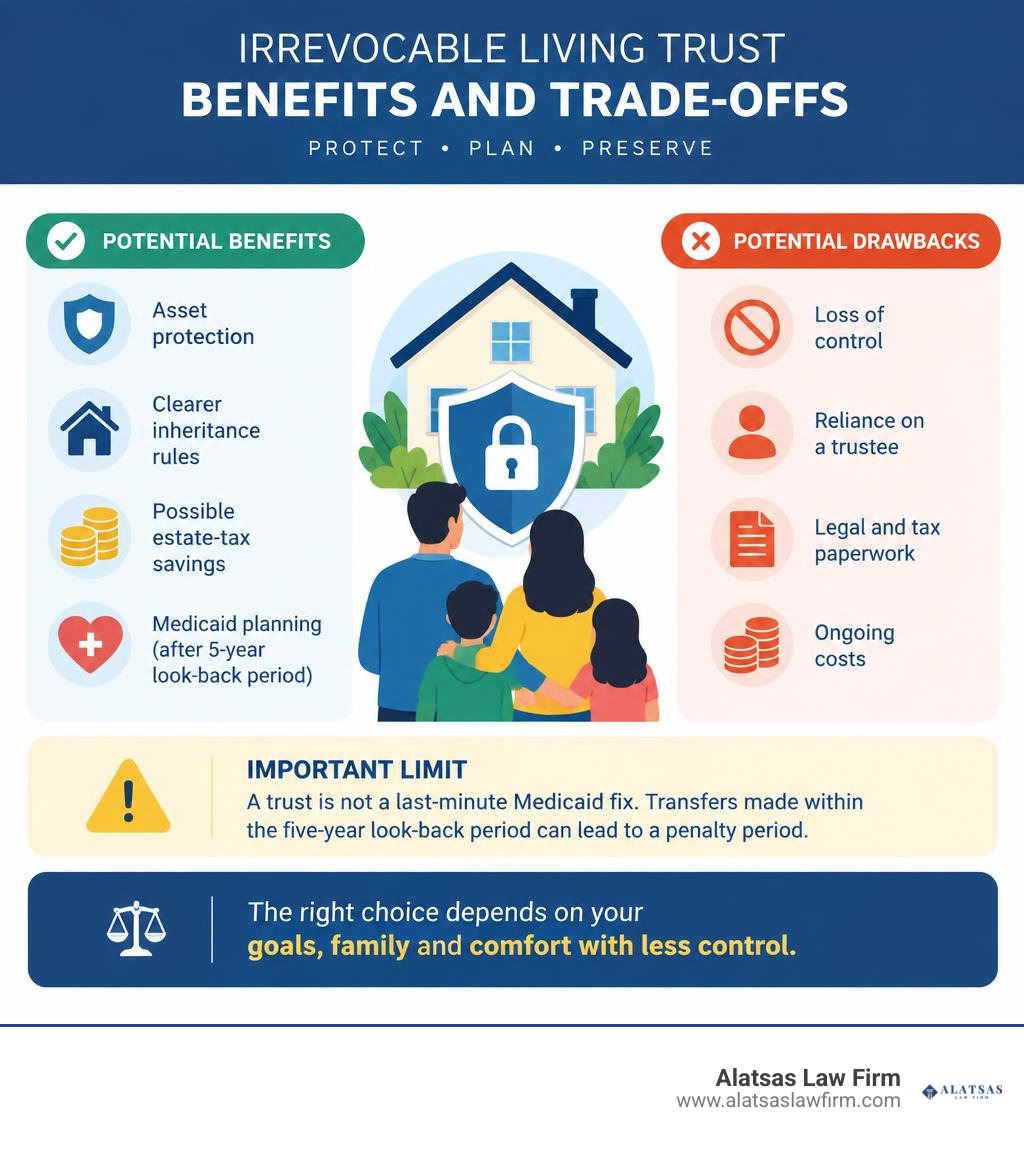
An irrevocable living trust may help protect a home or savings from certain creditors, reduce estate-tax exposure for some families, and support long-term-care Medicaid planning. The central trade-off is permanent: after assets are transferred, you generally cannot reclaim them or rewrite the terms by yourself.
For Brooklyn families, the key question is whether added protection is worth giving up direct control.
- Potential benefits: asset protection, inheritance controls, probate avoidance, possible tax savings, and Medicaid planning when transfers are made early enough.
- Potential drawbacks: less control, an independent trustee, tax and administrative work, and ongoing costs.
- Important limit: transfers within Medicaid's five-year look-back period may cause a period of ineligibility for long-term-care benefits.
An irrevocable trust is a targeted tool—not an automatic replacement for a will or revocable trust. The American Bar Association's overview of revocable living trusts explains the contrast between revocable and irrevocable planning.
I am Theodore Alatsas, an estate-planning, elder-law, and asset-protection attorney. This guide explains where an irrevocable trust can help and where its limits matter.
Understanding the Irrevocable Living Trust Structure and Mechanics
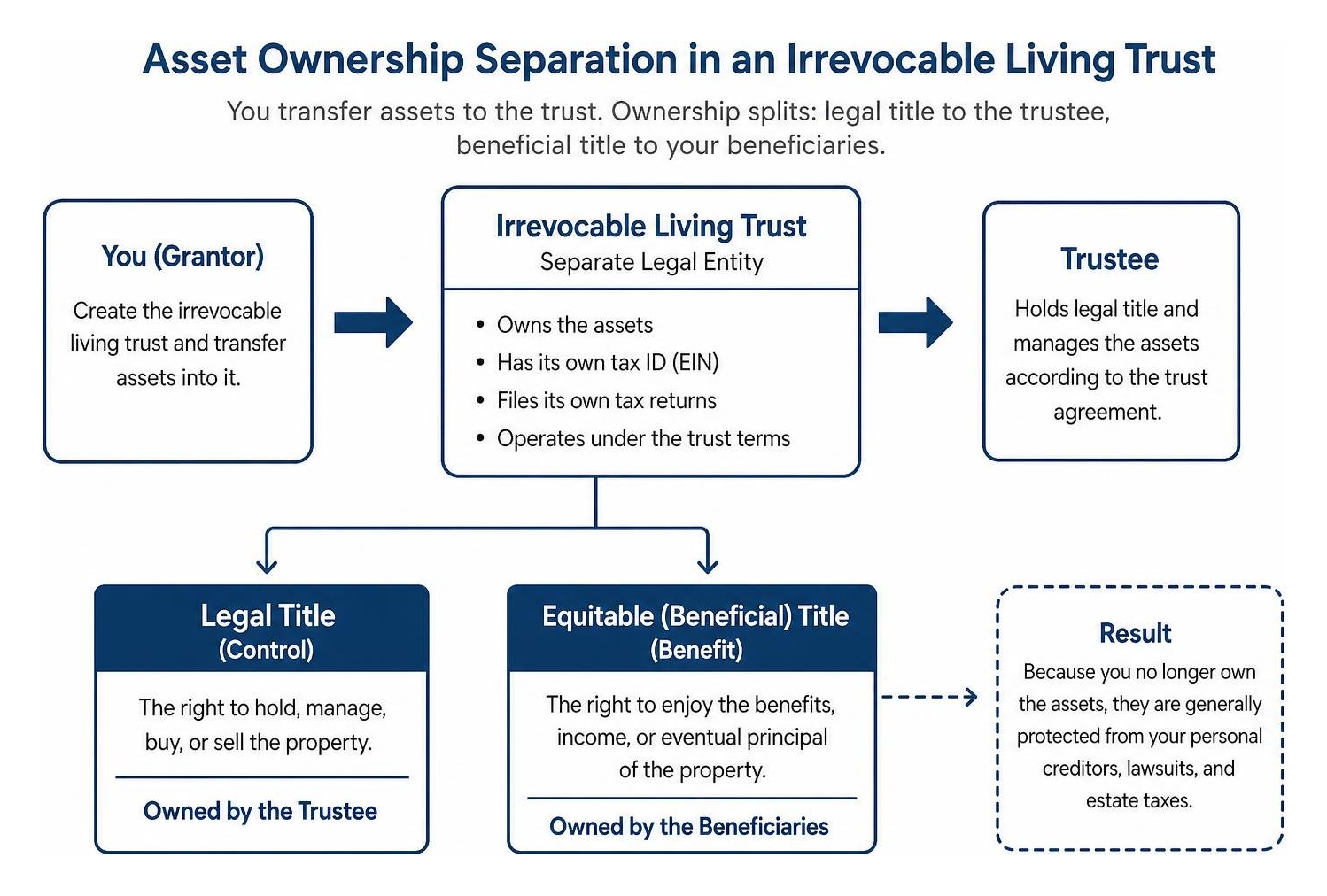
An irrevocable living trust is created during your lifetime to hold and distribute property. You are the grantor; a trustee manages the property for the named beneficiaries.
Unlike a revocable trust, this arrangement is intended to operate independently from you after funding. Depending on how it is drafted and taxed, the trust may need its own EIN and fiduciary income-tax return.
Funding is essential. Real estate deeds, financial accounts, and other assets must be properly retitled or assigned to the trust. Signing the document alone does not transfer ownership or create the intended protections.
How an Irrevocable Trust Restructures Asset Ownership
The trustee holds legal title and manages trust property under the agreement. Beneficiaries hold the right to receive income or principal as the document permits. That separation can protect trust property, but it also means the grantor cannot use it as personal property.
Common Types of Irrevocable Trusts

- Medicaid Asset Protection Trust (MAPT): Used in long-term-care planning, subject to Medicaid eligibility and look-back rules.
- Irrevocable Life Insurance Trust (ILIT): Holds life insurance to address estate-planning and liquidity goals.
- Dynasty trust: Preserves family wealth for multiple generations.
- Charitable remainder trust (CRT): Provides an income interest before remaining assets pass to charity.
- Spendthrift trust: Limits a beneficiary's ability to assign interests and can offer creditor protection.
Analyzing Irrevocable Living Trust Pros and Cons for Long-Term Security
An irrevocable trust exchanges flexibility for potentially stronger legal and financial protections.
Core Advantages: Asset Protection, Tax Shielding, and Medicaid Eligibility
Key reasons families consider one include:
- Creditor and lawsuit protection: Properly transferred assets may be less exposed to the grantor's future personal claims.
- Long-term-care planning: A properly designed trust may help preserve assets for family members after applicable Medicaid look-back rules have been satisfied.
- Estate-tax planning: Removing assets and future appreciation from an estate can be useful for families facing federal or New York estate-tax exposure.
- Protection for beneficiaries: Spendthrift provisions can help guard inheritances against creditors, divorce, or poor financial decisions.
- Probate avoidance and privacy: Trust property typically passes outside probate.
Strategic Disadvantages: Loss of Control, Administrative Burden, and Compressed Tax Brackets
The costs of those benefits are meaningful:
- Less personal control: You usually cannot revoke the trust or demand assets back.
- Higher tax rates on retained income: Trust income-tax brackets are compressed, so undistributed income can reach high rates quickly.
- Ongoing administration: Separate records, accounts, and fiduciary tax filings may be required.
- Professional costs: Drafting, funding, trustee services, and tax preparation can add expense.
Weighing Irrevocable Living Trust Pros and Cons for Tax and Medicaid Planning
Timing and New York law matter. New York has its own estate-tax rules, including a potentially significant threshold effect, so estate planning should account for both state and federal law.
For Medicaid long-term-care planning, an uncompensated transfer can be reviewed for the prior 60 months. Creating a trust shortly before care is needed may therefore create a penalty rather than immediate eligibility. Individual circumstances and the exact trust terms are critical.
Irrevocable vs. Revocable Trusts: Choosing the Right Vehicle
Revocable trusts favor control and probate avoidance. Irrevocable trusts may provide stronger protection and tax-planning benefits, but only because the grantor gives up important ownership rights.
Irrevocable Living Trust Pros and Cons vs. Revocable Living Trusts
| Feature | Revocable Living Trust | Irrevocable Living Trust |
|---|---|---|
| Grantor control | Can generally amend or revoke | Cannot usually change or revoke alone |
| Probate avoidance | Yes, if funded | Yes, if funded |
| Creditor protection | Generally no | May offer meaningful protection when properly structured |
| Medicaid planning | Assets generally remain countable | May help after applicable look-back rules are met |
| Estate-tax planning | Assets remain in the estate | May remove transferred assets and appreciation from the estate |
| Tax administration | Often reported by the grantor | May require a separate EIN and Form 1041 |
Can an Irrevocable Trust Ever Be Modified?
“Irrevocable” does not always mean impossible to adjust. Depending on New York law and the document, options may include:
- Decanting assets into a new trust with updated administrative terms.
- Using a trust protector with limited powers, such as replacing a trustee.
- A nonjudicial settlement agreement when all required parties agree.
- Court modification when unforeseen circumstances undermine the trust's purpose.
These paths are limited and should be evaluated before—not after—assets are transferred.
Financial Costs and Practical Considerations of Irrevocable Trusts
An irrevocable trust requires both an upfront investment and ongoing administration.
Initial Setup and Maintenance Expenses

Common costs include legal drafting, deed and account retitling, fiduciary tax preparation, and trustee compensation. Fees vary widely with the assets involved, trust complexity, and whether a family member or professional trustee serves.
Ideal Candidates and Real-World Scenarios
An irrevocable trust may be worth exploring for:
- Professionals or business owners concerned about future liability.
- Healthy older adults planning well ahead for possible long-term-care needs.
- New York families with estates that may face state estate tax.
- Parents who want structured distributions for heirs facing debt, divorce, addiction, or financial-management challenges.
It is generally not the right choice for someone who needs unrestricted access to every asset or expects frequent changes to beneficiaries and distribution terms.
Frequently Asked Questions About Irrevocable Living Trusts
What is the primary difference between a revocable and irrevocable trust?
The difference is control versus protection. A revocable trust can generally be changed or ended by its creator, but its assets remain the creator's property. An irrevocable trust transfers ownership under the trust terms, which can support protection and tax-planning objectives but reduces the grantor's control.
How does an irrevocable trust affect Medicaid planning during the look-back period?
For long-term-care Medicaid, transfers made during the prior 60 months may be reviewed. Funding an irrevocable trust during that period can lead to a penalty period rather than immediate eligibility. After the applicable period, a properly structured trust may be treated differently from assets held personally, but eligibility depends on the facts and current rules.
Can I change the trustee or beneficiaries once the trust is established?
Usually not by yourself. A well-drafted trust may permit an independent trust protector, limited power of appointment, trustee removal process, decanting, or another lawful modification mechanism. The available option depends on the document and New York law.
Conclusion
An irrevocable trust can offer meaningful protection from certain creditor claims, long-term-care costs, and estate taxes, but it requires a real surrender of control and careful administration.
For Brooklyn families, the right plan depends on health, assets, family dynamics, and timing. Alatsas Law Firm can help you compare an irrevocable trust with a revocable trust, will, or other New York estate-planning option.
For a related overview, read our guide to choosing between a living trust or will for your family.
Contact Alatsas Law Firm to schedule a free consultation and discuss how to protect what you have built.