Blended families face a specific legal risk that traditional families rarely encounter: without a proper estate plan, your assets can end up with the wrong people, and a judge decides who that is, not you. Step-children can be completely cut out under default state rules. A surviving spouse can inherit everything and later leave it all to their own kids. The ten strategies below are what actually protect everyone in a blended family, starting with the most important choice you'll make.
1. Alatsas Law Firm, Tailored Estate Plans for Blended Families in Brooklyn (Our Top Pick)
Alatsas Law Firm is a boutique Brooklyn estate planning practice with over 25 years of experience. We focus on the families that standard estate planning templates ignore, blended households with step-children, prior marriages, and competing inheritance interests.

Blended families need more than a generic will. They need a plan that threads together trusts, beneficiary designations, and titling so every layer works toward the same goal. We build that coordination from scratch, customized to your actual family structure and the assets you've built.
We serve families in Brooklyn, Queens, and Staten Island. What separates us from document-prep services is the attorney relationship: we listen carefully, flag the issues you haven't thought of yet, and draft documents that hold up when the pressure is real. Our guide on balancing spousal rights and children from prior relationships explains how New York's elective share rules interact with trust planning, a nuance that online tools simply miss.
One honest caveat: boutique firms require a real attorney relationship. If you want a form filled in tonight, we're not that. But if you want a plan that actually works when it matters, that's exactly what we do.
2. A Dedicated Will, Define Who Gets What Before the Court Decides
A will is the foundation. Without one, New York's intestacy rules take over, and those rules were not written with blended families in mind. Under default law, a surviving spouse and biological children split the estate. Step-children get nothing unless they were legally adopted.

A properly drafted will names your executor, directs your probate assets, and can specify exactly what goes to your biological children versus your step-children. It can carve out specific items, the family home, a savings account, heirlooms, and assign them to the people you actually intend to receive them.
The limitation is real, though. A will only controls probate assets. Retirement accounts, life insurance, jointly titled property, and trust assets all pass outside the will. That's why a will alone is rarely enough for a blended family. A will becomes a public record through probate, meaning the terms are visible to anyone who looks. For families with step-children from multiple relationships, a trust often provides more privacy and flexibility.
Think of your will as the catch-all, it covers what the trust doesn't, names guardians for minor children, and tells your executor how to handle whatever's left. It's necessary, but it works best as part of a bigger plan.
3. Revocable Living Trust, Keep Assets Out of Probate and in the Right Hands
A revocable living trust is the workhorse of blended family estate planning. While you're alive, you control it completely. You can change it, add to it, or dissolve it. When you die, assets inside the trust transfer directly to your named beneficiaries, no probate, no court, no public record.

For blended families, this matters for one specific reason: probate takes time, and during that window, family conflict can escalate into litigation. A trust sidesteps that entirely. Assets move on your timeline, not the court's.
The trust also lets you set conditions. You can specify that your biological children inherit a fixed dollar amount at your death, while your surviving spouse keeps access to the home during their lifetime. These instructions survive your death and bind the trustee, which is exactly what makes a trust more powerful than a conversation or a handshake agreement.
One common mistake: people create a trust but never fund it. If your accounts and property aren't titled in the trust's name, the trust does nothing. Our estate planning guide for blended families covers trust funding in detail, because a signed document that isn't funded is just paper.
4. AB Bypass Trust, Let Each Spouse Control Their Own Half of the Estate
An AB bypass trust, also called an AB trust, splits the marital estate into two parts when the first spouse dies. Trust A holds the surviving spouse's assets, which they control freely. Trust B holds the deceased spouse's assets in an irrevocable structure.

The surviving spouse can draw income from both trusts during their lifetime. But they cannot change the beneficiaries of Trust B. Whatever the first spouse designated, typically children from a prior marriage, is locked in. The surviving spouse can't redirect those assets to their own kids, or to a new partner if they remarry.
This structure solves one of the most common blended family disasters. Without it, everything passes to the surviving spouse outright, and they can do whatever they want: update their own estate plan, remarry, spend the assets down, or leave everything to their biological children. Cases where the first spouse's children ended up with nothing precisely because the survivor changed their plan after the first death are a well-documented concern in blended family estate planning.
A QTIP trust works similarly, the surviving spouse receives income for life, but the grantor controls where the principal ultimately goes. QTIP trusts are especially popular with entrepreneurs who want to pass business ownership shares to specific heirs while still providing for a surviving spouse.
AB trusts give the surviving spouse slightly more control over the Trust A portion, since that trust is revocable in their name. The trade-off is complexity, two trusts cost more to set up and require more administration than a single revocable trust. For families with significant separate assets or children from different relationships, it's usually worth it.
5. Updated Beneficiary Designations, Retirement Accounts and Life Insurance
Beneficiary designations override your will. That sentence alone is worth re-reading. If your IRA still names your ex-spouse as beneficiary, that's who gets the money, regardless of what your will says, regardless of your current marriage, regardless of anything your attorney drafted.

For blended families, this is a critical audit point. Every retirement account, life insurance policy, annuity, and payable-on-death bank account needs a current beneficiary designation that matches your actual intent. These assets pass outside probate entirely, which is efficient, but also means your estate plan documents have zero control over them unless you update the forms.
Life insurance is especially useful in blended family planning. You can name your biological children as beneficiaries of a life insurance policy, freeing up other assets for your surviving spouse. The policy pays directly to the children at your death, so they don't have to wait for the surviving spouse to die to receive an inheritance.
An Irrevocable Life Insurance Trust (ILIT) takes this a step further. The trust owns the policy, so the death benefit isn't included in your taxable estate. The trustee distributes proceeds under the terms you set, useful when you want to make sure the money reaches specific people in a specific way, not just a lump sum to an 18-year-old.
Review beneficiary designations every time there's a major life change: a marriage, a divorce, a birth, a death. The form is simple; the consequences of ignoring it are not.
6. Choosing the Right Trustee or Executor, Individual vs. Corporate Trustee
The person or institution you name as trustee or executor has enormous power over what actually happens after you die. In blended families, this choice requires more thought than usual, because step-family dynamics can turn a well-meaning family member into an inadvertent source of conflict.

An individual trustee, typically a trusted family member or close friend, knows the people involved and can make judgment calls with personal context. The downside is exactly that: personal context. If your adult child from your first marriage is trustee, your surviving spouse may feel watched. If your surviving spouse is trustee of your children's subtrust, your children may feel underrepresented. A neutral party often works better in blended families precisely because they have no stake in the outcome.
A corporate trustee, a bank trust department or professional fiduciary, brings institutional accountability, clear record-keeping, and no emotional investment. They follow the document exactly. They won't favor one branch of the family over another. The cost is higher than using a family member, and they tend to be less flexible on distributions that require judgment calls the trust document doesn't explicitly address.
Many blended families use a hybrid approach: a family member as co-trustee for personal decisions and a corporate trustee for investment management and accounting. Some attorneys also recommend naming a trust protector, a neutral third party who can resolve disputes between the trustee and beneficiaries without going to court.
The executor of your will has a similar role during probate. In blended families, think carefully before naming a spouse or adult child who has a financial interest in the outcome. Someone with no inheritance at stake can administer the estate more cleanly.
7. Prenuptial and Postnuptial Agreements, Bloodline Protection Integrated with Your Estate Plan
Prenuptial and postnuptial agreements aren't just for divorce protection. In blended family planning, they're one of the most direct ways to protect assets for children from a prior marriage, and to make sure both spouses understand the plan going in.
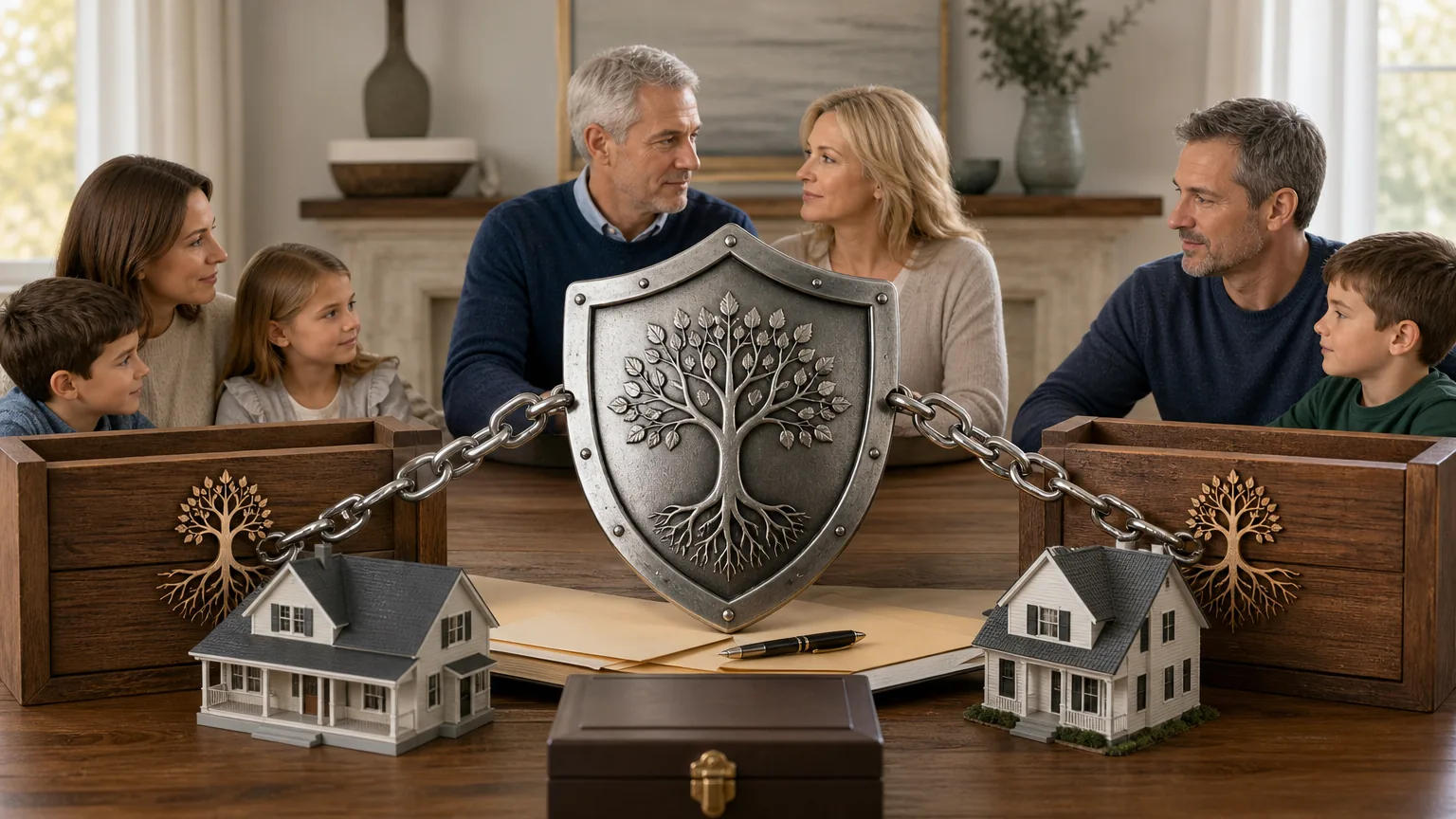
A prenuptial agreement, signed before the marriage, can define which assets remain separate property. This matters because New York's elective share law gives a surviving spouse the right to claim a portion of the estate even if the will says otherwise. A properly drafted prenuptial agreement, combined with the right trust structure, can limit that claim and preserve more for your biological children.
Postnuptial agreements, signed after the marriage, serve the same purpose for couples who didn't plan before the wedding. They're slightly harder to enforce because both spouses must negotiate from an existing relationship, but they're a valid tool when circumstances change mid-marriage, such as receiving a large inheritance or starting a business.
What many people miss is the integration between these agreements and estate documents. A prenuptial agreement that contradicts your trust structure creates confusion. An attorney who understands both family law and estate planning, like the team at Alatsas Law Firm's estate planning practice for non-traditional families, can coordinate these documents so they reinforce each other rather than create gaps.
Think of the prenuptial agreement as the outer wall and the trust as the inner structure. Both need to be built from the same blueprint.
8. Age-Based and Conditional Distribution Provisions, Prevent Premature Inheritances
Most estate planning attorneys will tell you that handing a 21-year-old a $250,000 inheritance outright rarely ends well. In blended families, where children from different relationships may be at very different life stages, age-based distribution triggers become even more important.

A trust can hold a beneficiary's share and release it in stages: a portion at 25, more at 30, and the balance at 40. The trustee can make discretionary distributions before those ages for education, health expenses, or a home purchase, but the bulk of the inheritance stays protected until the beneficiary is actually ready to manage it.
Among experienced planners, 40 is a common age for outright distribution. The trustee monitors the beneficiary's situation and can accelerate distributions if the person is clearly ready. This keeps the plan flexible while protecting against impulsive decisions in early adulthood.
Conditional provisions go a step further. A trust can specify that a beneficiary loses access to principal if they fail to meet certain conditions, completing a degree, avoiding specific behaviors, or maintaining sobriety. These conditions are legal in New York, but they require careful drafting to avoid being challenged as unreasonable restraints.
In blended families specifically, age-based triggers help manage fairness. If one set of children is older and financially established while another set is still young, you can calibrate the distribution schedule separately for each group rather than treating everyone identically.
9. Dynasty Trusts and Generation-Skipping Trusts, Advanced Tax-Saving for Blended Families
For families with substantial assets, the federal estate tax, currently applied to estates above the applicable exemption threshold, can take a significant bite. Generation-skipping trusts (GSTs) and dynasty trusts are designed to minimize that exposure across multiple generations.
A generation-skipping trust passes assets to grandchildren or later generations, bypassing the estate tax that would otherwise apply at each generation. For blended families, this matters because you can direct which branch of your family benefits. Assets in a GST for your biological grandchildren are protected from your surviving spouse's future estate and from any new family branches that develop after your death.
A dynasty trust takes this further, it's designed to hold assets for multiple generations, sometimes for decades. States have different rules on how long a trust can last. New York has its own perpetuities rules that govern these structures, so the drafting has to be state-specific.
These tools aren't relevant for every blended family. They make the most sense when the combined estate is large enough that estate tax is a real concern, or when you want to protect a family business or significant real estate from being broken up across competing heirs. An experienced estate planning attorney can run the numbers to show whether the complexity of a dynasty trust structure is actually worth it in your specific situation.
10. Long-Term Care Insurance, Protecting the Surviving Spouse Without Draining Inheritance
Long-term care costs can destroy an estate plan. A nursing home stay in New York averages tens of thousands of dollars per year. Without coverage, those costs come directly from the assets your estate plan was designed to protect, leaving less for both the surviving spouse and the children.
In blended families, this creates a specific tension. The surviving spouse needs care, which depletes the estate. The children from the first marriage watch their expected inheritance shrink. Even with the best intentions and a well-drafted trust, a long nursing home stay can make the distribution plan irrelevant because there's nothing left to distribute.
Long-term care insurance addresses this by covering the cost of care separately, outside the estate. The surviving spouse gets the care they need; the estate stays intact for the beneficiaries the first spouse intended. It's one of the cleanest ways to honor both obligations at once.
Hybrid life insurance policies with long-term care riders are another option. They provide a death benefit if care is never needed, and they convert to long-term care coverage if it is. For blended families where both spouses want to preserve something for their respective children, these products can simplify the planning considerably. Talk to an estate planning attorney who also understands Medicaid planning, because if long-term care insurance lapses or isn't purchased, Medicaid eligibility rules will reshape what you can do with your assets.
DIY Estate Planning Tools vs. Hiring an Attorney for Blended Families
Online estate planning tools have gotten better. But they were built for simple estates, one spouse, biological children, straightforward asset distribution. Blended families are exactly the situation where those templates fail.
| Factor | DIY Online Tools | Estate Planning Attorney |
|---|---|---|
| Cost upfront | Low (pricing varies) | Higher (pricing varies by complexity) |
| Handles blended family complexity | Rarely — generic templates | Yes — customized to your structure |
| Coordinates trusts, wills, and beneficiary forms | No | Yes |
| State-specific compliance (NY rules) | Inconsistent | Required by professional obligation |
| Risk of document invalidation | High — execution errors are common | Low — attorney supervises signing |
| Updates as laws or family change | User's responsibility — often never done | Attorney can flag and update proactively |
| Protects against contested estates | Poor — no legal representation | Strong — attorney can testify to intent |
The real cost of a DIY plan isn't the price of the software, it's what happens when the plan fails. A will that wasn't witnessed correctly is invalid. A trust that was never funded does nothing. A beneficiary designation that was never updated overrides the entire plan. For blended families, the stakes of getting this wrong are especially high because there are competing parties who may challenge anything ambiguous.
Online tools lack the flexibility needed to address specific family dynamics. What seems like a simple form can produce a document that doesn't reflect what you actually intended, and by the time that's discovered, it's too late to fix it.
What to Look for When Choosing an Estate Planning Attorney for Your Blended Family
Not every estate planning attorney has handled the specific dynamics of blended families. Here's what to look for when you're choosing one.
- Experience with trust planning for blended families. Ask directly. An attorney who mostly drafts simple wills may not be familiar with AB trusts, QTIP structures, or dynasty trusts.
- Fluency in both family law and estate law. Prenuptial agreements and elective share rules interact with estate documents. An attorney who understands both sides can catch conflicts before they become problems.
- Willingness to coordinate all the pieces. Wills, trusts, deeds, beneficiary forms, and powers of attorney all need to work together. If the attorney only handles one of those, you'll need someone else to connect the dots, and gaps happen in the handoff.
- Local knowledge. New York has its own probate rules, elective share calculations, and Medicaid planning timelines. A New York estate planning attorney knows what matters in Surrogate's Court.
- Clear communication. You should understand what your documents do and why. If an attorney can't explain your plan in plain language, that's a warning sign.
The relationship matters as much as the documents. Estate planning for blended families requires honest conversations about money, family dynamics, and what you actually want, not just what's polite to say out loud.
Frequently Asked Questions
Do step-children automatically inherit under New York law?
No. Under New York intestacy rules, step-children have no automatic inheritance rights unless they were legally adopted. If you die without a will or trust that specifically names your step-children, they receive nothing. Estate planning for blended families must explicitly include step-children in the documents to ensure they're protected. This is one of the most common gaps in plans drafted without attorney guidance.
Can my surviving spouse change my estate plan after I die?
If you leave assets to your spouse outright, with no trust, they can do whatever they want with those assets, including updating their own estate plan to exclude your children entirely. A bypass trust or QTIP trust prevents this by locking in your designated beneficiaries for the assets in Trust B. Your spouse receives income and benefits, but can't redirect the principal away from your chosen heirs.
How often should a blended family update their estate plan?
Review your plan after any major life event: a marriage, divorce, birth, death, significant change in assets, or change in relevant law. For blended families, even changes in the family relationships, a step-child becoming estranged, or a new grandchild, may warrant a review. Most estate planning attorneys recommend a check-in every three to five years at minimum, sooner if things shift.
What happens to my house if I die and my spouse remarries?
Without planning, your spouse inherits the house outright and can leave it to anyone, including a new spouse. A right of occupancy or life estate provision in a trust lets your spouse live in the home during their lifetime, then transfers it to your intended beneficiaries, typically your biological children, when the surviving spouse dies or moves out. California and other states have specific property tax implications worth checking with a local attorney.
Is a prenuptial agreement necessary for blended family estate planning?
Not always required, but often useful. New York's elective share law gives a surviving spouse rights to a portion of your estate even if your will says otherwise. A prenuptial agreement, properly coordinated with your trust documents, can limit that claim and preserve more for your children from a prior relationship. It also forces an honest conversation about financial intentions before the marriage, which reduces conflict later.
Can I leave different amounts to children from different marriages?
Yes. You can distribute your estate any way you choose. Some families split assets equally across all children regardless of parentage. Others allocate based on need, age, or existing inheritance from the other parent. A trust lets you structure these distinctions clearly and with conditions, so your reasoning is embedded in the document rather than left to family memory.
Conclusion
Estate planning for blended families isn't complicated because families are complicated, it's complicated because the law wasn't designed with your specific family in mind. The strategies above, from a dedicated will through long-term care insurance, are the tools that close that gap. The single most important next step is a conversation with an attorney who actually handles these cases. If you're in Brooklyn, Queens, or Staten Island, the usable guide to choosing the right estate plan is a good place to start before you sit down with anyone.