
Every Brooklyn family wants peace of mind when it comes to protecting what they have worked hard for. Understanding probate avoidance becomes crucial as the traditional court process for distributing assets often causes unnecessary delays, higher expenses, and unwanted public exposure. This guide will help you discover probate avoidance techniques like revocable living trusts and joint ownership, so your loved ones can inherit with fewer legal hurdles and your family’s privacy stays protected.
Key Takeaways
| Point | Details |
|---|---|
| Probate Avoidance Benefits | Minimizing legal costs and maintaining family privacy are key advantages of probate avoidance strategies. |
| Effective Techniques | Tools such as Revocable Living Trusts and Joint Tenancy streamline asset transfers without court intervention. |
| Legal Challenges | Common pitfalls include outdated beneficiary designations and inadequate trust funding, which can lead to unexpected probate proceedings. |
| Financial Implications | Probate can drain estate value through costs; avoiding probate maintains assets and privacy for families. |
Defining Probate Avoidance And Its Purpose
Probate avoidance is a strategic approach families use to transfer assets smoothly and privately after a loved one’s passing. Probate represents a court-supervised legal process that validates wills and manages property distribution, which can often become time-consuming and expensive for Brooklyn families.
At its core, probate avoidance involves creating legal mechanisms that allow assets to transfer directly to heirs without going through traditional court proceedings. Court-supervised asset transfer strategies enable families to maintain privacy and reduce potential legal complications.
The primary purposes of probate avoidance include:
- Minimizing legal expenses associated with court proceedings
- Reducing potential delays in asset distribution
- Maintaining family privacy during sensitive transfer periods
- Preventing potential disputes among potential heirs
- Protecting the total value of the estate from unnecessary administrative costs
Legal strategies for probate avoidance typically involve sophisticated estate planning techniques. These can include establishing revocable living trusts, creating joint ownership arrangements, and utilizing payable-on-death designations for financial accounts. Each method offers unique advantages in bypassing traditional probate requirements.
Pro tip: Consult an experienced elder law attorney to develop a personalized probate avoidance strategy tailored to your family’s specific financial landscape.
Key Probate Avoidance Techniques In New York
New York residents have several sophisticated strategies to navigate probate challenges and protect their family’s assets. Probate avoidance methods in New York provide families with flexible approaches to streamline asset transfer and minimize legal complications.
The most effective probate avoidance techniques in New York include:
- Establishing a revocable living trust
- Creating joint tenancy with right of survivorship
- Utilizing payable-on-death account designations
- Recording strategic property deed transfers
- Implementing transfer-on-death registrations for investments
A revocable living trust stands out as a powerful tool for Brooklyn families. By transferring asset ownership to the trust, individuals can ensure smooth property transition without court intervention. This approach allows immediate asset distribution to beneficiaries, bypassing the traditional probate process.

Joint ownership arrangements also offer significant advantages in New York. When property is held in joint tenancy with right of survivorship, the asset automatically transfers to the surviving owner upon one owner’s death. This method effectively eliminates the need for probate court proceedings, providing a seamless transfer mechanism.
Financial accounts provide additional probate avoidance opportunities. Beneficiary designation strategies enable direct transfers of bank accounts, retirement funds, and investment portfolios without court involvement. These designations allow immediate access to funds, reducing potential financial strain during an already challenging time.
Below is a comparison of common probate avoidance tools used by families in New York:
| Probate Avoidance Tool | Main Benefit | Typical Use Case | Potential Drawback |
|---|---|---|---|
| Revocable Living Trust | Immediate asset transfer | Broad estate management | Requires formal setup |
| Joint Tenancy | Automatic property transfer | Real estate or shared bank accounts | May create equal ownership issues |
| Beneficiary Designation | Direct fund access | Financial accounts and investments | Needs regular updating |
| Transfer-on-Death (TOD) | Simplified investment transfer | Stocks and brokerage portfolios | Not available for all assets |
Pro tip: Consult an experienced New York elder law attorney to customize a comprehensive probate avoidance strategy tailored to your specific family assets and financial landscape.
How Probate-Avoiding Tools Work Together
Probate avoidance requires a strategic, multi-layered approach that combines different legal mechanisms to protect family assets. Comprehensive estate planning strategies enable Brooklyn families to create robust protection networks that minimize court involvement and preserve wealth.
The most effective probate avoidance strategies work synergistically through complementary tools:
- Revocable living trusts as central asset management platforms
- Beneficiary designations for direct account transfers
- Joint tenancy arrangements for immediate property ownership shifts
- Payable-on-death (POD) account mechanisms
- Transfer-on-death (TOD) registrations for investments
A revocable living trust serves as the foundational tool, providing a comprehensive umbrella for asset management. By centralizing property ownership within the trust, families can create a flexible framework that allows immediate asset distribution while bypassing traditional probate procedures.
Beneficiary designations and transfer mechanisms act as complementary strategies. These tools enable specific assets like bank accounts, retirement funds, and investment portfolios to transfer directly to intended recipients, circumventing lengthy court processes. Joint tenancy further enhances this approach by allowing automatic property transfer to surviving owners.
Effective estate planning requires integrating multiple probate avoidance tools to create a seamless, comprehensive asset protection strategy.
The intersection of these tools creates a powerful protective network. Each mechanism addresses different aspects of asset transfer, ensuring that families can navigate inheritance challenges with minimal legal complications and maximum financial efficiency.
Pro tip: Consult an experienced estate planning attorney to design a customized probate avoidance strategy that precisely matches your family’s unique financial landscape.
Legal Hurdles And Common Pitfalls To Avoid
Navigating probate avoidance requires understanding the complex legal landscape that can quickly derail even well-intentioned estate plans. Critical estate planning challenges emerge when families fail to anticipate potential legal obstacles that could compromise their asset protection strategies.
Common legal hurdles in probate avoidance include:
- Inadequate trust funding
- Outdated beneficiary designations
- Improperly structured joint ownership
- Incomplete or non-compliant legal documentation
- Failure to update estate planning documents regularly
One of the most significant pitfalls occurs when families incorrectly assume all assets will automatically bypass probate. Certain property types require specific legal mechanisms to avoid court intervention. Failing to properly title assets or maintain comprehensive documentation can result in unexpected probate proceedings, potentially consuming significant time and financial resources.
Beneficiary designations represent another critical area where legal complications frequently arise. Many individuals create these designations once and never revisit them, overlooking critical life changes like marriages, divorces, or the birth of children. These outdated designations can create unexpected legal challenges, potentially redirecting assets contrary to the original intention.
Proactive estate planning demands consistent review and strategic legal documentation to minimize potential probate complications.
Executors and trustees without comprehensive legal understanding can inadvertently trigger probate complications. Complex family dynamics, unclear asset ownership, or imprecise language in estate documents can lead to prolonged legal disputes that diminish the estate’s value and create emotional strain for surviving family members.
Pro tip: Schedule an annual estate planning review with a qualified attorney to ensure your probate avoidance strategy remains current and legally robust.
Costs, Privacy, And Asset Protection Impacts
Probate can significantly drain family resources through complex legal expenses and public scrutiny. Estate transfer financial implications reveal multiple hidden costs that can substantially reduce inheritance value and expose sensitive family information.
The primary financial impacts of probate include:
- Court filing fees
- Executor compensation
- Attorney legal charges
- Asset appraisal expenses
- Potential estate taxation
- Extended legal processing costs
Probate proceedings create substantial financial burdens that can consume a significant percentage of an estate’s total value. Typical probate expenses range between 4-7% of the total estate worth, which can translate to tens of thousands of dollars in unnecessary costs for Brooklyn families.
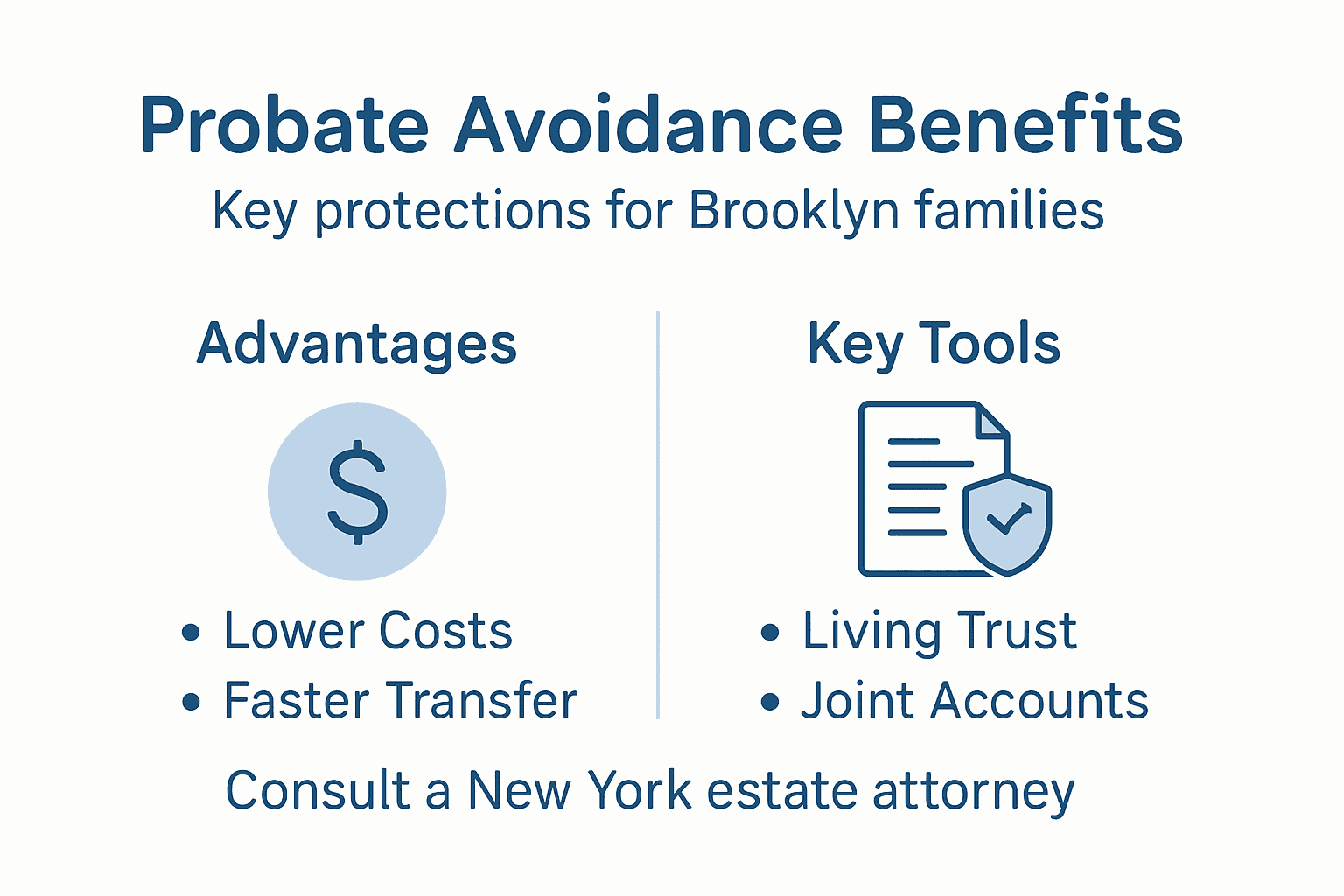
Privacy represents another critical concern in probate processes. Court proceedings become public records, meaning anyone can potentially access details about asset distribution, family dynamics, and financial holdings. This public exposure can create uncomfortable situations and potential conflicts among family members or attract unwanted external attention.
Here’s a summary of the financial and privacy impacts of going through probate versus avoiding it:
| Aspect | Traditional Probate | Probate Avoidance |
|---|---|---|
| Cost to Estate | 4-7% of estate value | Minimal legal fees |
| Process Duration | Months to years | Weeks to immediate distribution |
| Privacy | Public court records | Private family arrangements |
| Asset Protection | Increased risk of disputes | Greater control and protection |
Effective probate avoidance strategies protect both financial resources and family privacy, creating a more secure inheritance pathway.
Asset protection emerges as a fundamental benefit of strategic probate avoidance. By implementing tools like living trusts and beneficiary designations, families can maintain greater control over their assets, minimize tax implications, and ensure smoother wealth transfer with minimal external interference.
Pro tip: Consult a local estate planning professional to develop a comprehensive strategy that maximizes asset preservation and minimizes public exposure.
Secure Your Family’s Future With Expert Probate Avoidance Strategies
Understanding how probate avoidance protects Brooklyn families from costly delays and public court proceedings can bring you peace of mind during difficult times. If you want to minimize legal expenses, maintain privacy, and ensure your assets transfer smoothly to your loved ones probate avoidance tools like revocable living trusts and beneficiary designations are essential. This article highlights the common pitfalls and benefits that every family should consider before navigating these complex issues alone.
Take control of your estate planning today by partnering with experienced professionals who specialize in elder law and asset protection. At Alatsas Law Firm we provide personalized legal solutions designed specifically for Brooklyn families facing probate challenges. Learn how integrating multiple probate avoidance tools can protect your family’s wealth and reduce stress by visiting our Contact page now. Don’t wait until delays or disputes arise take the first step towards clarity and security by scheduling a consultation with our trusted team.
Frequently Asked Questions
What is probate avoidance?
Probate avoidance is a strategic approach that allows families to transfer assets smoothly and privately after a loved one’s death, bypassing the traditional court-supervised probate process.
Why is probate avoidance important for families?
Probate avoidance is crucial as it minimizes legal expenses, reduces delays in asset distribution, maintains family privacy, prevents potential disputes among heirs, and protects the estate’s total value from unnecessary administrative costs.
What are some common techniques for probate avoidance?
Key techniques for probate avoidance include establishing revocable living trusts, creating joint tenancy with right of survivorship, utilizing payable-on-death designations for accounts, and implementing transfer-on-death registrations for investments.
How do joint ownership arrangements help in probate avoidance?
Joint ownership arrangements, such as joint tenancy with right of survivorship, ensure that upon one owner’s death, the asset automatically transfers to the surviving owner, effectively eliminating the need for probate court proceedings.