Families can avoid Medicaid estate recovery by using irrevocable Medicaid Asset Protection Trusts, life estate or Lady Bird deeds, caregiver-child transfers, and non-probate beneficiary titling before long-term care is needed. These strategies keep qualifying assets out of the probate estate that state recovery programs target.
Under federal law (specifically 42 U.S.C. § 1396p), every state must operate a Medicaid Estate Recovery Program (MERP). This requirement originated with the Omnibus Budget Reconciliation Act of 1993 (OBRA-93). When a Medicaid recipient who was age 55 or older passes away, the state is mandated to seek repayment from their estate for certain Long-Term Services and Supports (LTSS). These covered services include:
- Nursing facility services
- Home and Community-Based Services (HCBS)
- Related hospital stays and prescription drug costs provided while receiving long-term care
In some instances, states may also use TEFRA pre-death liens against real estate if an individual is permanently institutionalized, unless certain protected relatives reside in the home.
Despite the aggressive reputation of these programs, national estate recovery collections are relatively modest compared to overall spending. Recoveries total roughly $733.4 million annually—amounting to only about 0.55 percent of total fee-for-service LTSS expenditures. However, because MERP places claims on personal residences and modest family savings, it often creates a severe "chilling effect," discouraging low-income seniors from seeking the essential healthcare they need out of fear of losing generational wealth.
Understanding how your state defines an "estate" is the first step in protecting your family's assets.
| Category | Probate-Only States (e.g., New York) | Expanded Recovery States (e.g., Ohio) |
|---|---|---|
| Estate Definition | Limited to assets passing through probate court under state probate law. | Includes non-probate assets in which the recipient had legal title or interest at death. |
| Real Property (Life Estates / Lady Bird Deeds) | Generally fully protected from post-death recovery claims. | Often subject to recovery up to the value of the decedent's interest at death. |
| Joint Tenancy / Survivorship Accounts | Passes directly to surviving co-owner without recovery exposure. | State can pursue the decedent's fractional share from the surviving owner. |
| Revocable Living Trusts | Passes to trust beneficiaries outside probate; immune from claims. | Assets in revocable trusts remain fully vulnerable to estate recovery liens. |
| Beneficiary Designations (TOD / POD / Life Insurance) | Paid directly to named beneficiaries without estate recovery interference. | Recoverable in states electing broad definitions of non-probate assets. |
Probate-Only vs. Expanded Estate Recovery States
The distinction between probate-only and expanded recovery states represents one of the largest variations in elder law across the country.
Approximately 20 to 22 states stick to the narrow, traditional federal floor: the probate estate. In a probate-only jurisdiction like New York, the state can only file a claim against assets that pass through the Surrogate's Court under a will or administration proceeding. If an asset transfers automatically upon death via joint tenancy, beneficiary designations, life estates, or trusts, it bypasses probate entirely and is shielded from post-death claims. Learn more about understanding Medicaid recovery in New York to see how these distinctions apply locally.
Conversely, roughly 25 to 30 states have elected an expanded estate recovery definition. In these states (such as Ohio and Wisconsin), the state can pursue non-probate property, including:
- Real estate passing through joint tenancy with right of survivorship
- Retained life estates and enhanced life estate deeds
- Living revocable trusts
- Payable-on-Death (POD) and Transfer-on-Death (TOD) accounts
State-Specific Thresholds and Recent Reforms
State rules continue to evolve through legislative updates and federal mandates:
- Georgia: Waives estate recovery claims against the first $25,000 of any estate subject to recovery for deaths occurring on or after July 1, 2018.
- Texas: Maintains a cost-effectiveness minimum claim threshold, declining to pursue estates valued under $10,000.
- Massachusetts: Enacted major structural reforms narrowing its recovery scope strictly to federally mandated long-term care costs for individuals 55 and older, cutting back older broad-recovery practices.
- California: Ended broad expanded estate recovery in 2017 to align with probate-only rules. Furthermore, effective January 1, 2026, California phased in a transitional 30-month look-back period for nursing home care that counts only transfers made on or after that date.
- Federal Legislation (OBBBA): The One Big Beautiful Bill Act of 2025 (Pub. L. 119-21) established that effective January 1, 2028, non-agricultural home equity limits for Medicaid eligibility will be capped at a flat $1,000,000, eliminating ongoing CPI adjustments. In 2026, the allowable home equity ceiling ranges from $752,000 to $1,130,000 depending on state discretion. For broader context on how these rules operate, see Medicaid estate recovery.
Legal Strategies to Avoid Medicaid Estate Recovery
Relying on good luck or an ordinary last will and testament will not protect your assets from state recovery claims. A will guarantees that an asset must go through probate, which directly exposes it to recovery in probate-only states.
To safeguard your home and life savings, you must use proactive, legally sound planning strategies well before long-term care becomes necessary. Exploring ways of protecting your home from Medicaid recovery helps keep your family's real estate intact for the next generation.
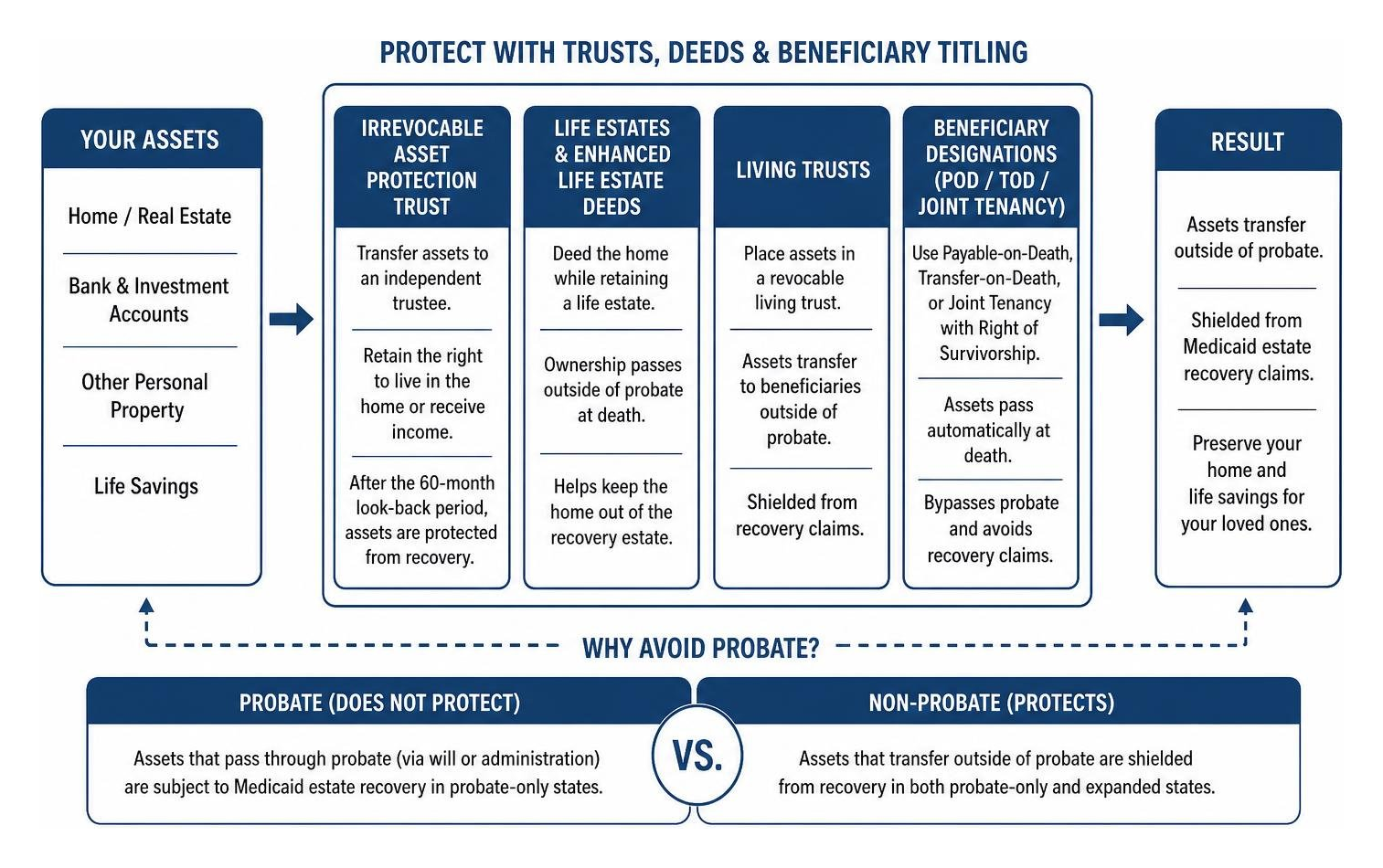
Establishing a Medicaid Asset Protection Trust to Avoid Medicaid Estate Recovery
The gold standard for comprehensive asset preservation is an irrevocable Medicaid Asset Protection Trust (MAPT). When you establish a MAPT, you transfer legal title of your home or liquid savings to an independent trustee (such as an adult child) while retaining the exclusive right to live in the home, collect rental income, or receive trust-generated income.
Because the trust is irrevocable and the principal cannot be distributed back to you, the underlying assets are not counted toward Medicaid's strict resource limits. Once the trust passes the standard 60-month (5-year) look-back period, the assets are completely protected.
Upon your passing, trust property passes directly to your named beneficiaries outside of probate court, making it an ideal vehicle to protect your assets. For more details on structure and trustee selection, explore our guide to the Medicaid Asset Protection Trust. Additionally, learn how to avoid Medicaid liens with an irrevocable trust to prevent pre-death liens while receiving care.
Utilizing Life Estate Deeds and Lady Bird Deeds to Avoid Medicaid Estate Recovery
Deed restructuring offers another way to bypass probate for residential real estate:
- Traditional Life Estate Deeds: You deed your property to your heirs (the remainder beneficiaries) while reserving a lifetime right to reside in the home (the life tenant). In probate-only states like New York, the life tenant's interest extinguishes entirely upon death, transferring clear title to the heirs without going through probate. However, creating a traditional life estate triggers a 60-month look-back transfer penalty based on the actuarial value of the remainder interest.
- Enhanced Life Estate Deeds (Lady Bird Deeds): Recognized primarily in five states (Florida, Michigan, Texas, Vermont, and West Virginia), a Lady Bird deed allows you to retain total control over the property during your lifetime—including the right to sell, mortgage, or revoke the deed without the beneficiaries' permission. Because the transfer is not complete until death, it does not trigger a transfer penalty during the look-back period and avoids probate at death.
The Caregiver-Child Exemption and Lifetime Property Transfers
Federal law provides a critical statutory exception under 42 U.S.C. § 1396p(c)(2)(A)(iv) known as the Caregiver-Child Exemption. This rule allows an individual to transfer their primary residence to an adult child without incurring a Medicaid transfer penalty or violating look-back rules, provided specific conditions are met:
- The child must have resided in the parent's primary home for at least two consecutive years immediately prior to the parent entering a nursing home or receiving long-term institutional care.
- The child must have provided direct care that effectively allowed the parent to remain safely at home rather than requiring earlier placement in a nursing facility.
This transfer must be completed during the parent's lifetime and requires clear medical and residency documentation, including physician affidavits detailing the care provided and verifying that it delayed institutionalization.
Mandatory Federal Exemptions, Spousal Protections, and Hardship Waivers

Federal statute 42 U.S.C. § 1396p(b)(2) establishes strict categorical bars prohibiting states from recovering long-term care costs under specific family circumstances.
The state is completely barred from pursuing an estate recovery claim if any of the following individuals survive the deceased Medicaid recipient:
- A surviving spouse (recovery is deferred until after the surviving spouse's death, though in probate-only states, non-probate assets passing to the spouse often permanently escape recovery).
- A child under 21 years of age.
- A child of any age who is blind or permanently and totally disabled under Social Security standards.
For married couples, the Community Spouse Resource Allowance (CSRA) protects a substantial portion of the couple's liquid assets (up to $157,920 in 2025, indexed annually for inflation) to ensure the healthy spouse is not left impoverished.
In situations where a community spouse holds assets exceeding the limit, specific legal maneuvers—such as spousal refusal in New York—allow the institutionalized spouse to receive coverage while the community spouse maintains their independent wealth. Review our analysis on can Medicaid take your home in NY for an in-depth breakdown of how family home exemptions operate in practice.
Qualifying for an Undue Hardship Waiver
If an estate is subject to an estate recovery claim, heirs can request an undue hardship waiver. Under CMS guidelines, states must establish clear procedures to waive or compromise claims when recovery would cause severe financial distress.
Common grounds for receiving an undue hardship waiver include:
- The asset is a family farm or family business that represents the primary source of income and livelihood for the surviving heirs.
- The property is a modest family residence (often defined as a home valued at 50% or less of the county's average home price) where the surviving heir has lived continuously and has no other housing options.
- The heir's household income falls below the federal poverty line.
Undue hardship applications carry strict deadlines—typically requiring the family to file clear and convincing documentation within 30 to 90 days of receiving the state's formal recovery notice.
Treatment of Retirement Accounts, Life Insurance, and Joint Assets
Asset types are handled differently depending on account titling and whether you reside in a probate-only or expanded recovery jurisdiction:
- Retirement Accounts (401k, IRA, 403b): In probate-only states, retirement accounts that name designated individuals as primary beneficiaries pass outside of probate and avoid recovery. If left to the "estate," they enter probate and become exposed to recovery claims.
- Life Insurance: Policy death benefits payable to named beneficiaries transfer without probate and are generally safe. However, the cash surrender value of a whole-life policy owned by the recipient during life can be counted toward Medicaid eligibility limits.
- Joint Tenancy with Right of Survivorship (JTWROS): In probate-only states, joint property passes instantly to the surviving joint tenant upon death, bypassing probate court and estate recovery. In expanded recovery states, the state may place a post-death lien on the value of the deceased recipient's fractional interest.
Frequently Asked Questions About Medicaid Estate Recovery
Can Medicaid take your house while you are still alive?
No. Medicaid will not seize your home while you are alive. Your primary residence is generally considered an exempt asset for Medicaid eligibility purposes up to state equity limits (between $752,000 and $1,130,000 in 2026), provided you or your spouse live there, or you express a formal subjective "intent to return home."
While states may file a pre-death TEFRA lien if you are permanently institutionalized without exempt family members in the home, this lien simply secures repayment if the property is sold during your lifetime.
How does the 5-year look-back period affect estate recovery planning?
Medicaid imposes a strict 60-month (5-year) look-back period on all uncompensated asset transfers (gifts) made prior to applying for nursing home Medicaid or HCBS waivers. Transferring assets for less than fair market value within this window triggers a penalty period of Medicaid ineligibility based on the transferred amount divided by the state's average monthly cost of nursing care.
Proper planning requires implementing trusts and property transfers at least five years before applying for benefits. In California, a shorter 30-month look-back rule applies to nursing home care transfers made on or after January 1, 2026.
What happens if an estate has no assets at the time of death?
If a deceased Medicaid recipient leaves an insolvent estate with zero probate assets (or no assets within the state's recovery definition), the state's claim is deemed uncollectible.
Medicaid estate recovery is strictly an in rem claim against the decedent's property—heirs, children, and family members are never personally liable for paying back Medicaid debts from their own personal funds. When there are no estate assets, the claim is closed without recovery.
Conclusion
Protecting your life savings and family home requires a clear strategy implemented well ahead of time. Waiting until a health crisis strikes limits your available legal options and puts your estate at risk of state claims.
At Alatsas Law Firm, we use a personalized three-pillar protection framework backed by nearly 30 years of dedicated elder-law experience. We help families create tailored plans—using irrevocable trusts, strategic deed planning, and spousal protections—to secure Medicaid coverage without risking the family home.
To get started on your asset protection strategy, discover practical tools for outsmarting the Medicaid 5-year lookback with effective strategies, or contact our office today to schedule your consultation.