
The main advantages of a trust over a will are that a properly funded living trust can usually avoid probate, keep asset details private, let a successor trustee manage property if you become incapacitated, and set clearer rules for when beneficiaries receive money. A will still matters, especially for naming a guardian for minor children, but it generally takes effect only after death and must pass through probate.
For many Brooklyn families, the practical question is simple: will your family need quick access to a home, savings, or other assets if you become ill or die? Probate can take months and often costs 3% to 7% of an estate's gross value. A revocable living trust may reduce those delays and costs for assets that are actually transferred into it.
Only 45% of American adults have estate-planning documents. Starting with the right mix of a trust, will, beneficiary designations, and powers of attorney can give your family more clarity when they need it most.
I am Theodore Alatsas, a Brooklyn estate-planning attorney with more than 30 years of experience helping families understand the advantages of a trust over a will, including probate avoidance, incapacity planning, and protecting a home and savings. The choice is personal, but understanding how each tool works is the first step toward a plan that fits your family.
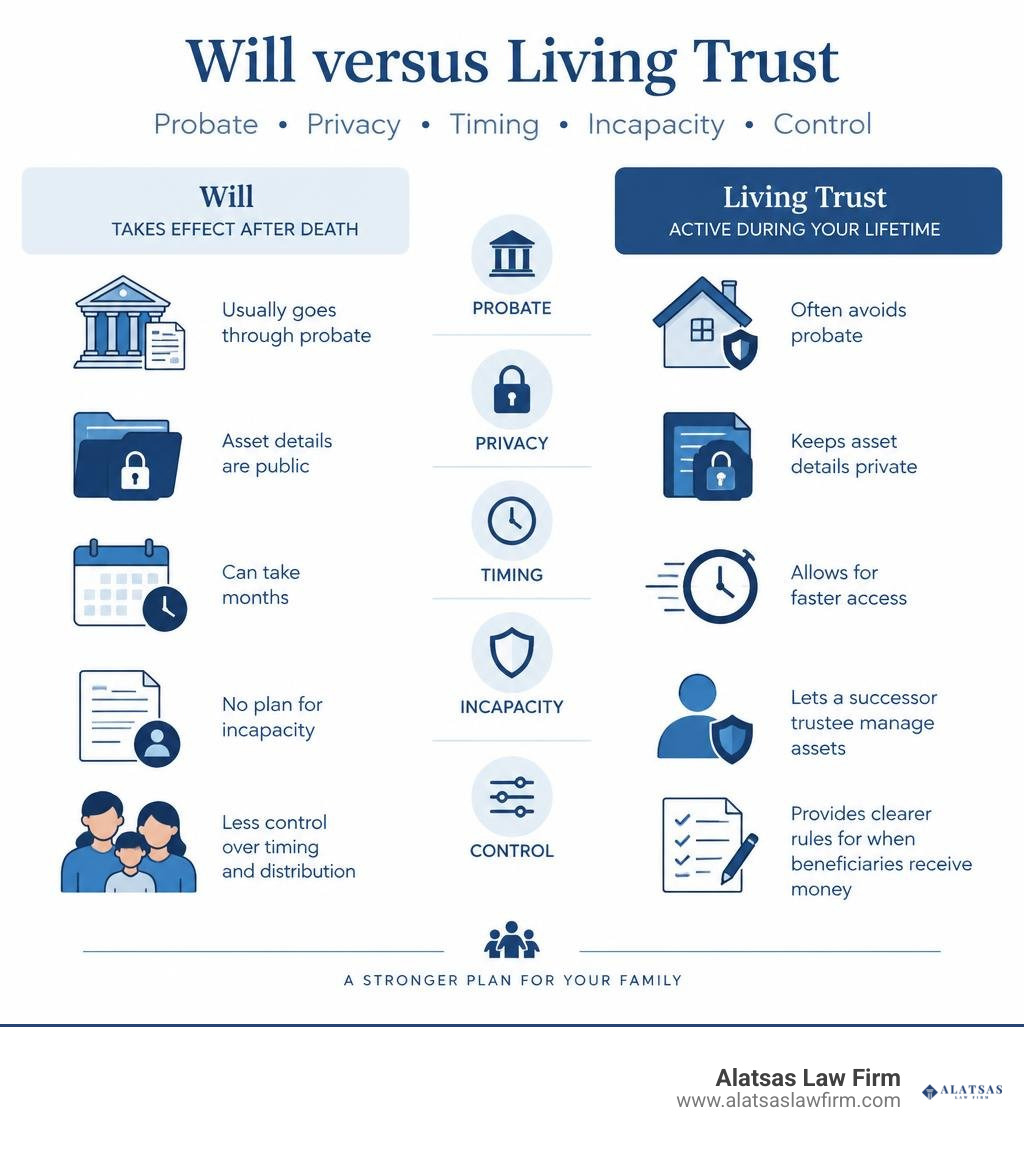
Understanding the Foundational Differences Between Wills and Trusts
Estate planning often gets reduced to drafting a single document, but deciding between a will-centered plan and a trust-centered plan fundamentally shapes how your family navigates the future. A last will and testament and a revocable living trust serve entirely distinct legal functions, become active at different times, and offer vastly different levels of protection.
A will is essentially a set of written instructions to a probate court outlining who should receive your property after your death and who should care for your minor children. A revocable living trust, on the other hand, is an independent legal entity created during your lifetime to hold ownership of your assets while allowing you to maintain complete control over them as the initial trustee.
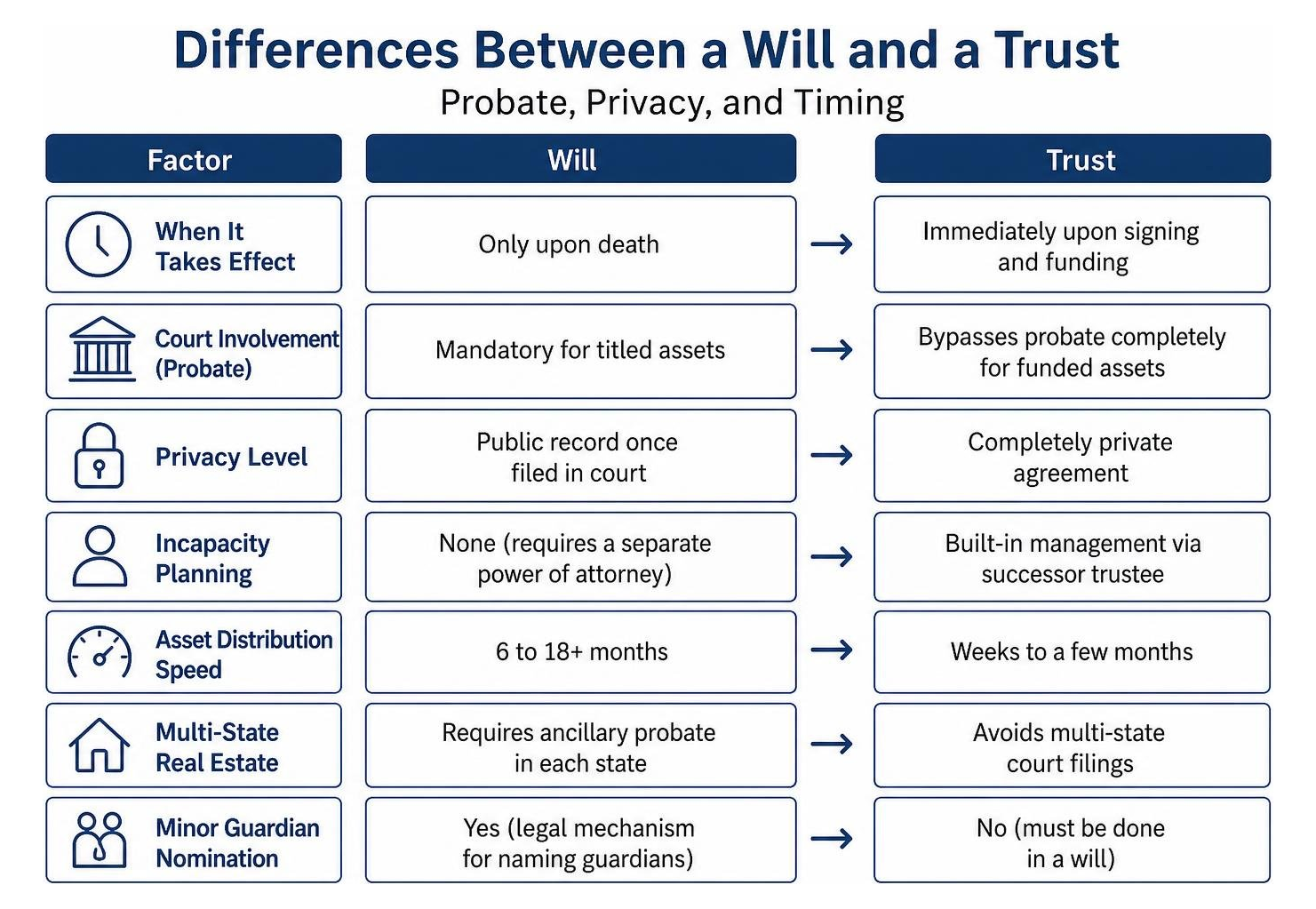
To see how these tools contrast side by side, review our breakdown of living trust vs. will: understanding these estate planning tools:
| Feature | Last Will and Testament | Revocable Living Trust |
|---|---|---|
| When It Takes Effect | Only upon death | Immediately upon signing and funding |
| Court Involvement (Probate) | Mandatory for titled assets | Bypasses probate completely for funded assets |
| Privacy Level | Public record once filed in court | Completely private agreement |
| Incapacity Planning | None (requires a separate power of attorney) | Built-in management via successor trustee |
| Asset Distribution Speed | 6 to 18+ months | Weeks to a few months |
| Multi-State Real Estate | Requires ancillary probate in each state | Avoids multi-state court filings |
| Minor Guardian Nomination | Yes (legal mechanism for naming guardians) | No (must be done in a will) |
How a Last Will and Testament Operates
A will only springs into action after you pass away. During your lifetime, a will has zero legal authority—it does not manage your property, protect you if you fall ill, or control how accounts are handled.
When you die, your named executor cannot simply show up at a bank with your will and take over accounts. The executor must first file the original will with the local probate court (known in New York as the Surrogate’s Court) to prove its validity. This process invites court oversight, requires formal notice to all legal heirs, and opens your private family affairs to public scrutiny. For an overview of this distinction, see this analysis on Will vs. Trust: Which Is Better for You? - LegalClarity.
How a Revocable Living Trust Functions
A revocable living trust begins working the moment you execute the agreement and transfer title of your assets into the trust's name—a process called "funding" the trust. As the grantor (creator), you typically name yourself as the primary trustee, meaning you retain complete ownership, check-writing authority, and control over your real estate and investments. You can buy, sell, spend, amend, or revoke the trust at any time.
Because the trust legally owns the assets rather than you as an individual, there is no need for a court process to transfer title when you pass away. Your handpicked successor trustee simply steps into your shoes to manage or distribute the assets according to your written terms. You can explore these mechanisms further by reading about the 10 surprising benefits of a revocable trust in New York.
Key Advantages of a Trust Over a Will in Modern Estate Planning

When evaluating modern estate planning options, the privacy and autonomy provided by a trust are among its greatest strengths. When a will enters probate, it becomes a permanent public record. Anyone—nosy neighbors, predatory salespeople, or estranged relatives—can request a copy from the court clerk to see your entire asset inventory, who received what, and who was left out.
In contrast, a living trust is a private contract. No documents are filed with the court, no asset values are published, and distribution details remain strictly between your successor trustee and named beneficiaries. For families seeking discretion, this distinction is invaluable.
Furthermore, if you own real estate in more than one state (such as a primary home in Brooklyn and a vacation condo in Florida), a will forces your family through "ancillary probate"—a secondary, expensive court proceeding in every state where you own land. Placing multi-state real estate into a single revocable trust eliminates the need for multiple probate cases entirely. For a deeper look, check out our insights on a comparison between trusts and wills.
Financial Advantages of a Trust Over a Will: Avoiding Probate Costs
Probate is rarely fast, and it is never free. Across the country, probate expenses—including court filing fees, statutory executor commissions, attorney retainers, appraisal costs, and publication fees—commonly consume 3% to 7% of an estate’s gross value.
For a $700,000 estate (a modest figure considering New York real estate values), probate can easily cost your family between $21,000 and $49,000 in administrative deductions. In places like California or New York, statutory legal schedules can produce substantial bills, such as roughly $23,000 on a $1 million estate.
Beyond dollars, probate exacts a steep time penalty. Routine probate proceedings routinely take 6 to 18 months—and significantly longer if a disgruntled heir contests the will. During this timeframe, family assets may be frozen, preventing timely sales of property or distribution of living funds. A funded living trust sidesteps the entire court apparatus, allowing successor trustees to distribute funds within weeks or months. We detail this direct mechanism in our guide on how revocable trusts avoid probate for your assets.
Long-Term Advantages of a Trust Over a Will for Asset Control
A will generally provides "all-or-nothing" lump-sum distributions once probate closes. If you leave money to a young adult child or grandchild through a will, they typically receive the entire inheritance outright as soon as they reach legal age, regardless of their financial maturity.
A trust gives you a lifetime remote control over asset distribution:
- Staggered Age Milestones: You can instruct your trustee to distribute principal in stages (e.g., one-third at age 25, one-third at 30, and the remainder at 35).
- Conditional Distributions: You can earmark distributions strictly for higher education tuition, down payments on a home, or medical emergencies.
- Spendthrift and Creditor Protection: You can protect inheritances from a beneficiary’s future creditors, lawsuits, or bankruptcy.
- Blended Family Harmony: In second marriages, a trust ensures that your surviving spouse is financially supported for life while guaranteeing that the remaining principal ultimately passes to your biological children rather than step-relatives.
Industry commentary often touches on these issues; for example, see the perspectives shared in Which Is Best For Your Estate Plan: A Will Or Trust? - Forbes.
Beyond Death: Incapacity Planning and Tax Considerations

Many people think estate planning is only about what happens when you die. However, lifetime planning is just as critical. If you suffer a severe stroke, develop dementia, or experience a debilitating accident, a will provides zero assistance because it only becomes effective upon death. Discover more on this topic in our resource on why to choose a trust instead of a will in New York.
Managing Assets During Cognitive Decline or Illness
If you become incapacitated without a trust, your family may be forced to petition a court for an expensive, stressful, and public conservatorship or guardianship proceeding to gain authority over your bank accounts and real estate.
With a revocable living trust, incapacity planning is seamless. If you become unable to manage your affairs, your named successor trustee can step in immediately without stepping foot in a courtroom. They can access trust accounts, pay your mortgage and healthcare bills, manage investments, and ensure your daily care is financed without interruption.
Estate and Gift Tax Realities in 2026
Tax planning is another area where trusts shine over standard wills:
- Federal Exemptions in 2026: As of September 2026, the federal estate tax exemption stands at $15,000,000 per individual ($30,000,000 for a married couple). The annual gift tax exclusion rate is $19,000 per recipient ($38,000 for married couples filing jointly).
- Revocable vs. Irrevocable Trusts: A basic revocable living trust is tax-neutral during your life (you report income on your personal return, and assets receive a stepped-up tax basis at your death). However, for high-net-worth estates or those planning for long-term care, specialized irrevocable trusts can permanently remove assets from your taxable gross estate or protect them against long-term nursing home costs. Wills offer no such structural tax shielding.
Integrating Both Tools: Why a Complete Plan Often Uses Both
Choosing a trust does not mean discarding a will entirely. In reality, a robust estate plan uses both instruments strategically rather than viewing them as mutually exclusive rivals.
A trust cannot handle every single legal necessity. Specifically, a trust cannot legally nominate a guardian for your minor children—that vital power belongs exclusively to a last will and testament.
Furthermore, even the most diligent individuals occasionally forget to retitle a newly opened bank account or acquired vehicle into their trust. To solve this, we draft a pour-over will. A pour-over will acts as an essential safety net: it captures any stray, unfunded assets upon your death and legally "pours" them into your existing trust, ensuring that your trust's distribution rules still govern your legacy. For a comprehensive look at how they interact, review our guide comparing a trust and a will as well as the practical breakdown in Will vs Living Trust (2026): Which Do You Need?.
Frequently Asked Questions about Trusts and Wills
What assets should not be placed into a revocable living trust?
While real estate, non-retirement brokerage accounts, and business interests belong inside your trust, certain assets should not be retitled into it directly:
- Qualified Retirement Accounts: Do not retitle 401(k)s, 403(b)s, or Traditional/Roth IRAs into the name of your trust, as this could trigger an immediate taxable event. Instead, designate appropriate primary and contingent beneficiaries directly on the account forms.
- Day-to-Day Checking Accounts: Modest checking accounts used for monthly bills can often remain in your name with a Payable on Death (POD) designation.
- Motor Vehicles: In many states, transferring everyday personal vehicles into a revocable trust creates unnecessary administrative headaches with local motor vehicle agencies and insurers.
Is a living trust more expensive to create than a will?
Yes, the initial upfront legal fees for a trust are higher than those for a simple will. An attorney-drafted simple will generally costs between $300 and $1,200, whereas a comprehensive revocable living trust package typically ranges from $1,500 to $5,000.
However, looking only at upfront costs is misleading. The higher initial investment in a trust typically saves tens of thousands of dollars in probate court costs, legal retainers, and administrative expenses down the road.
Does a will override a trust after someone dies?
No. A will does not override a valid trust. A will only controls property held in your individual name at the time of your death that does not have a designated beneficiary. Assets titled in the name of your revocable trust are controlled strictly by the terms of the trust agreement.
Conclusion
Every family’s financial footprint, family dynamic, and legacy goals are unique. While a simple will may suffice for modest estates without real estate, a revocable living trust offers unmatched advantages in avoiding probate expenses, preserving family privacy, protecting against sudden incapacity, and providing structured distributions for your loved ones.
At Alatsas Law Firm, we bring nearly 30 years of dedicated estate planning experience to Brooklyn families. Through our three-pillar protection framework, we help you tailor a customized plan that shields your hard-earned assets and provides total peace of mind for the next generation. We invite you to schedule a consultation with our experienced team to review your goals and discover the path that best protects your family. To explore which solution fits your household, see our comprehensive guide on choosing between a living trust or will: the best choice for your family, or speak directly with a Brooklyn estate planning will and trust attorney today.