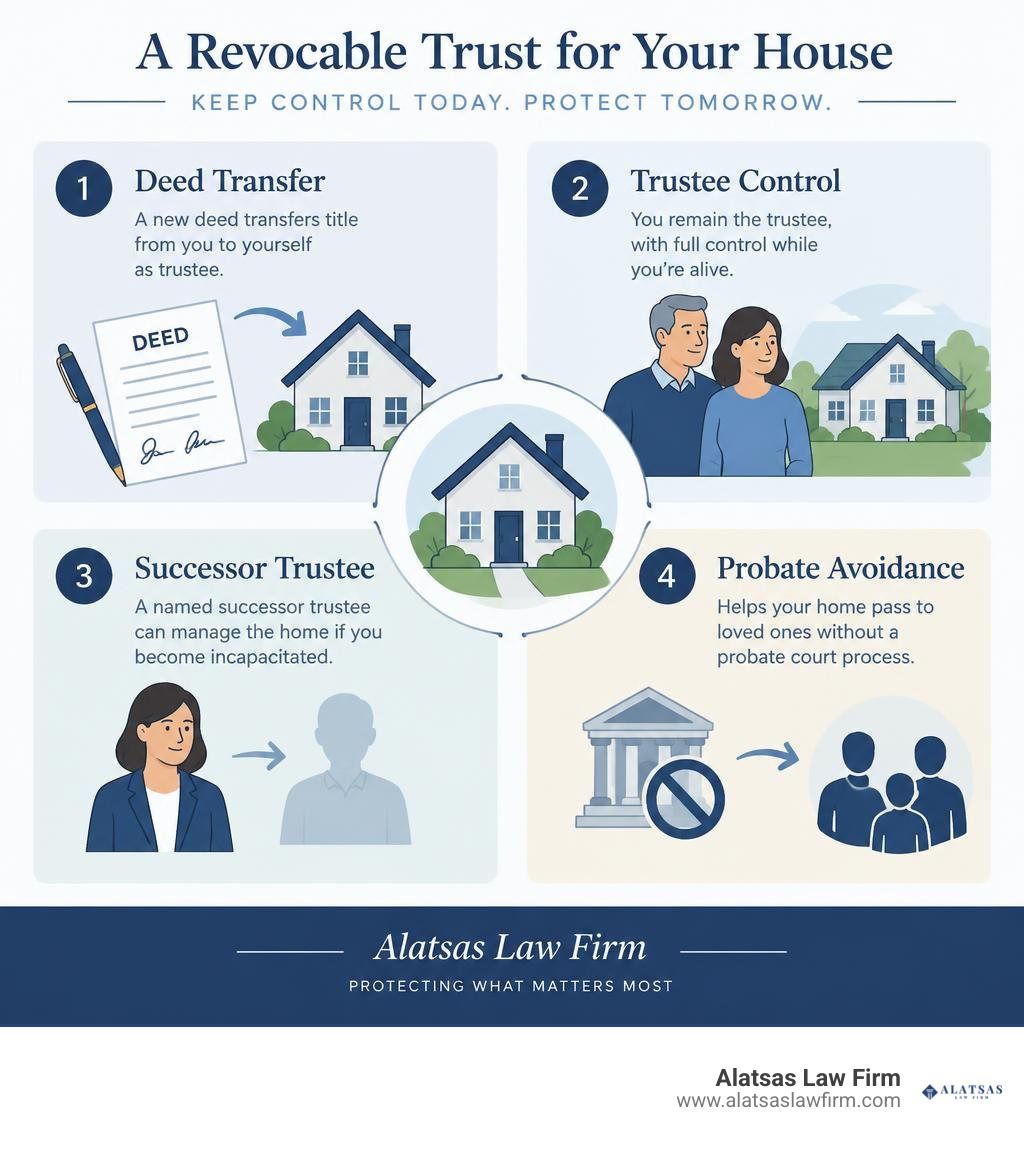
To put a house into a revocable living trust, create and sign the trust agreement, then sign and record a new deed that transfers title from you to yourself as trustee. You can usually remain the trustee, live in the home, pay the mortgage and taxes, sell it if needed, and change or revoke the trust while you are alive.
For many Brooklyn homeowners, a revocable trust for house ownership can help the property pass to loved ones without a probate court proceeding. It also gives a named successor trustee authority to manage the home if you become incapacitated, which can help avoid a court-appointed guardian or delays with mortgage payments, repairs, and property taxes.
A trust only works for your home after it is properly funded. That means the deed must be prepared correctly and recorded with the appropriate county land records office. You should also review your homeowners insurance, mortgage-servicer requirements, and any property-tax or homestead benefit rules that apply to your home.
I am Theodore Alatsas, a New York estate-planning attorney with more than 30 years of experience helping families protect homes, savings, and family plans. I help Brooklyn homeowners evaluate whether a revocable trust for house ownership fits their probate, incapacity, and long-term care planning needs.
Understanding How a Revocable Living Trust Works for Real Estate
When you establish a revocable living trust, you create a legal framework designed to hold and manage your assets during your lifetime and distribute them smoothly after your death. For real estate, this vehicle acts as a protective container for the title of your home.
The structure relies on three distinct roles, which often start with just one person or married couple:
- The Grantor (or Settlor): The person who creates the trust and transfers ownership of their property into it.
- The Trustee: The individual who holds legal title and manages the trust assets according to the trust agreement. In a standard revocable living trust, you serve as your own trustee.
- The Beneficiary: The person or group entitled to enjoy the benefit of the trust property. During your life, you are the primary beneficiary. You also name successor beneficiaries who inherit the property upon your death.

Understanding the distinction between legal and equitable title explains why you retain complete control over your home. When you transfer your property into the trust, legal title (the formal ownership on public records) shifts to you in your fiduciary capacity as trustee. Meanwhile, equitable title (the right to occupy, use, and benefit from the property) remains with you as the beneficiary.
Because the trust is fully revocable, you can amend its terms, sell the property, refinance your mortgage, or revoke the trust entirely at any time. If you decide to move, you do not need permission from the court or your future heirs to sell.
Beyond flexibility, holding real estate in a trust offers substantial privacy. When property passes through a last will and testament, the will becomes a public court record during probate, exposing your family's personal assets and real estate values to anyone who searches public filings. In contrast, a living trust is a private contract. The distribution of your home remains completely confidential. When evaluating your overall estate strategy, reviewing what revocable and irrevocable trusts are helps clarify which legal mechanism aligns with your long-term goals.
Revocable vs. Irrevocable Trusts for Real Property
While a revocable living trust provides maximum control and probate avoidance, it is not the only trust instrument available for real estate. An irrevocable trust requires the grantor to surrender direct control and the ability to alter the trust terms freely, but it offers specific protections that a revocable trust cannot provide.
The primary difference centers on asset protection and long-term care planning. Because you retain total ownership rights and the power to revoke a living trust, creditors can still attach claims to real estate held within it. Similarly, a revocable trust does not shield your primary residence from Medicaid estate recovery or long-term nursing home costs.
For homeowners concerned about the Medicaid lookback period (which is 60 months for nursing home care in New York), an irrevocable Medicaid Asset Protection Trust (MAPT) is often required. Reviewing an irrevocable vs revocable trusts comparison helps clarify the distinct roles each structure plays. If your primary goal involves health care planning and safeguarding your primary asset against catastrophic care expenses, you should explore our guide to protecting home assets from nursing home costs.
| Feature | Revocable Living Trust | Irrevocable Trust (e.g., MAPT) |
|---|---|---|
| Probate Avoidance | Yes, fully avoids probate | Yes, fully avoids probate |
| Grantor Control | Complete; can amend, revoke, or sell | Limited; independent trustee required |
| Medicaid / Nursing Home Protection | No protection against Medicaid recovery | Yes, protects home after lookback period |
| Creditor Protection During Life | No; reachable by personal creditors | Yes, shields real estate from future creditors |
| Tax Return Filing | Reported on personal Form 1040 | Often separate EIN or complex grantor rules |
| Step-Up in Basis at Death | Yes, full step-up to fair market value | Yes, if structured with retained life estate |
Protecting Property Rights and Homestead Exemptions
A common concern among property owners is whether placing a primary residence into a trust will eliminate valuable property tax exemptions, such as local homestead credits, senior citizen exemptions, or veteran abatements.
When drafted with appropriate statutory language, a revocable living trust preserves all your existing property tax benefits. In states and municipalities across the country, tax codes permit primary residences held in revocable trusts to maintain homestead exemptions, provided the grantor retains the explicit right to occupy the property rent-free for life.
Reviewing a standard revocable living trust agreement demonstrates how specific homestead clauses preserve these owner-occupancy rights while granting broad administrative powers to the trustee. In New York, for example, programs like the School Tax Relief (STAR) exemption remain fully intact after executing and recording a trust deed, ensuring your annual property tax obligations do not increase simply because you created a trust.
Why Creating a Revocable Trust for House Ownership Protects Your Family
When an individual passes away owning real estate solely in their personal name, that real estate is legally frozen. Even if the decedent left a comprehensive last will and testament, the property cannot be transferred, refinanced, or sold until the local probate court formally validates the will and issues letters testamentary to the executor.
Probate can be a lengthy and expensive ordeal. In urban jurisdictions like Brooklyn, probate court proceedings often take anywhere from six months to over a year, during which mortgage payments, maintenance fees, and property taxes must still be paid. Furthermore, statutory executor commissions and court filing fees can consume thousands of dollars from the estate's gross value.
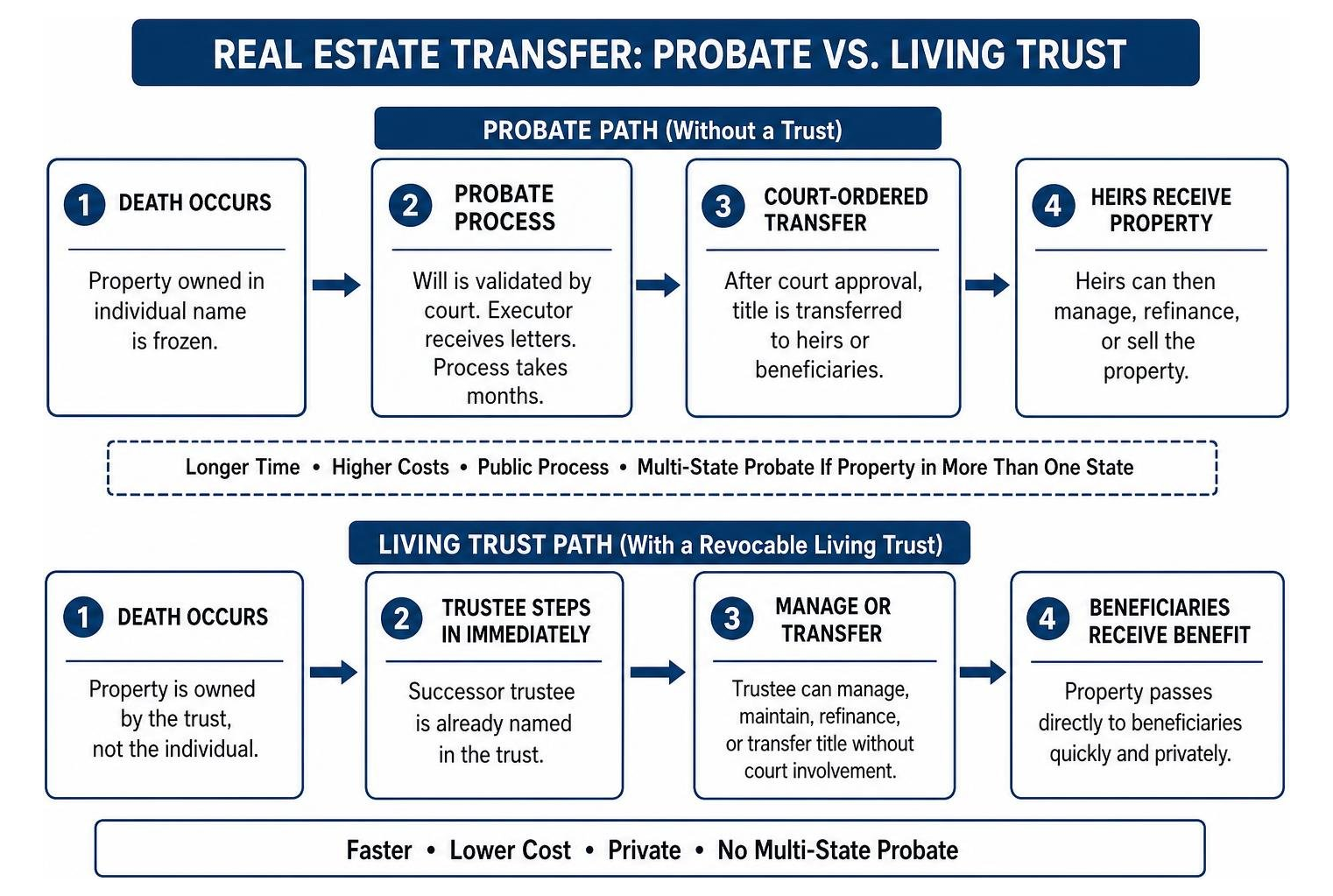
A revocable living trust bypasses this court process entirely. Because legal title rests with the trust rather than your individual estate, your named successor trustee can immediately manage the property, maintain carrying costs, or transfer title to your named beneficiaries without spending months waiting for a court date.
This privacy and efficiency are why many local homeowners utilize living trusts as the cornerstone of their estate plan.
Moreover, if you own real estate in more than one state—such as a primary residence in New York and a vacation property in Florida or Pennsylvania—dying without a trust requires your family to conduct a primary probate proceeding in your home state plus an ancillary probate proceeding in every other state where you owned real property. Placing all properties into a single revocable trust eliminates the expense and administrative headache of multi-state court proceedings.
Key Benefits of a Revocable Trust for House Property
Beyond probate avoidance, a revocable trust provides essential protections during your lifetime, particularly regarding incapacity planning:
- Incapacity Management Without Guardianship: If you suffer a severe illness, stroke, or cognitive decline, a power of attorney might not always provide complete authority for real estate management depending on banking institutions. With a trust, your co-trustee or successor trustee steps in immediately to manage mortgage payments, property repairs, and tax filings without requiring a costly and humiliating court-supervised adult guardianship proceeding.
- Seamless Management in Blended Families: Second marriages and blended families frequently face inheritance complications. A revocable trust allows you to grant a surviving spouse a life estate—permitting them to live in the home rent-free for the remainder of their life—while guaranteeing that the underlying property ultimately passes to your biological children upon the spouse's death.
- Protection for Minor and Young Heirs: If minor children or young adults inherit real estate directly through a will, the court may require a legal guardian of property until they reach the age of majority (typically 18 or 21). A trust allows you to establish a staggered distribution schedule (for example, releasing principal at ages 25, 30, and 35) while providing funds for their education and health needs in the interim.
If you are currently evaluating your real estate portfolio, determining whether your home belongs in a trust starts with assessing your family dynamics, mortgage obligations, and long-term inheritance wishes.
Financial and Tax Implications for Homeowners
Transferring your home into a revocable living trust carries straightforward, favorable tax treatment under federal and state law:
- Pass-Through Income Tax Status: A revocable living trust is considered a "grantor trust" by the IRS. For income tax purposes, the trust is legally transparent. You do not need to apply for a separate Employer Identification Number (EIN) during your lifetime or file a separate fiduciary tax return. All deductions, including mortgage interest and property tax write-offs, continue to be reported directly on your standard personal IRS Form 1040.
- Section 121 Capital Gains Exclusion: If you sell your primary residence while it is titled in your revocable trust, you retain full eligibility for the IRS Section 121 capital gains exclusion. This allows you to exclude up to $250,000 of capital gain (or $500,000 for married couples filing jointly) on the sale of a primary residence that you owned and lived in for at least two of the previous five years.
- Full Step-Up in Basis: When real property held in a revocable trust transfers to your beneficiaries upon your death, the tax basis of the home is adjusted to its fair market value on your date of death. This step-up in basis eliminates capital gains tax on all appreciation that occurred during your lifetime. For example, if you purchased a brownstone for $200,000 decades ago and it is worth $2,000,000 at your death, your children receive a stepped-up basis of $2,000,000. If they sell the property for that amount, they pay zero federal or state capital gains tax.
- Federal Estate Tax Considerations: Because you retain total ownership and control over the trust, the value of the home is included in your gross taxable estate upon death. However, under current 2026 federal tax law, the unified federal estate and gift tax exemption stands at approximately $15 million per individual (and roughly $30 million for married couples), meaning the vast majority of homeowners face no federal estate tax liability.
How to Transfer Real Estate into a Living Trust
Creating a valid trust document is only the first part of estate planning. An unfunded trust provides zero protection against probate. To protect your real estate, you must formally deed the property into the name of the trustee.

Understanding why every property owner needs a trust involves recognizing that your house is only protected once the county land registry officially shows the trust as the record owner.
Step-by-Step Process to Establish a Revocable Trust for House Assets
Transferring title to a trust requires precision. A single drafting error in a legal description can cloud title and create significant hurdles when you or your heirs attempt to sell the property later.
Here is the exact step-by-step process:
- Execute the Trust Agreement: Draft and execute the revocable living trust agreement in accordance with state statutory formalities, including signing before a notary public.
- Identify the Real Property on Schedule A: Every trust agreement includes an asset schedule (typically Schedule A) listing all initial assets intended for the trust, including the complete municipal address and legal description of the real property.
- Draft a New Property Deed: Prepare a new deed—typically a bargain and sale deed, special warranty deed, or quitclaim deed depending on local custom. The grantor on the deed will be you as an individual (e.g., Jane Doe), and the grantee will be you in your fiduciary capacity (e.g., Jane Doe, as Trustee of the Jane Doe Revocable Living Trust dated September 1, 2026).
- Prepare Required State and County Transfer Forms: In New York, deeds must be accompanied by state tax and transfer forms, including the TP-584 (Combined Real Estate Transfer Tax Return) and RP-5217 (Real Property Transfer Report), or their electronic equivalents in systems like ACRIS (Automated City Register Information System) in New York City.
- Sign and Notarize the Deed: Sign the new deed in the presence of a notary public. In certain states, independent witnesses must also observe the signing.
- Record the Deed with the County Recorder: Submit the signed deed and associated transfer tax documents to the county clerk or registrar of deeds in the county where the property is physically located, alongside the appropriate filing fees.
- Verify Public Recordation: After recording, obtain the recorded instrument number or liber/page reference to confirm that the chain of title reflects the trustee as legal owner.
Examining provisions in a standard living trust agreement highlights the exact grant of authority trustees need to acquire, encumber, and convey real estate without court oversight.
Managing Mortgages, Title Insurance, and Homeowners Insurance
Many homeowners worry that transferring a mortgaged property into a trust will trigger an acceleration clause, requiring immediate repayment of the outstanding loan balance.
Fortunately, federal law protects homeowners. Under the Garn-St. Germain Depository Institutions Act of 1982 (12 U.S.C. § 1701j-3), lenders are legally prohibited from enforcing a "due-on-sale" clause when residential real property with fewer than five dwelling units is transferred into an inter vivos trust in which the borrower remains a beneficiary and occupant. While you do not need lender permission, it is best practice to notify your mortgage servicer of the deed transfer and provide a copy of the recorded deed or a Certificate of Trust.
Additionally, you must coordinate with your insurance providers:
- Homeowners & Hazard Insurance: Contact your insurance carrier to add the trust as an "additional insured" or "additional interest" on your hazard and liability policies. This ensures that in the event of property damage or a personal injury lawsuit on the premises, the trust and trustee are fully covered.
- Title Insurance: In most instances, your existing owner’s title insurance policy continues to protect you when you transfer title to a revocable trust of which you are the grantor and trustee. However, you should review your specific title policy and consider obtaining an endorsement from your title insurance underwriter to maintain unbroken title protection.
Frequently Asked Questions About Putting a House in Trust
Can I sell or refinance my house after putting it in a revocable trust?
Yes. As the trustee of your revocable trust, you retain total legal authority to sell, lease, or refinance the property at any time. When you sell the home, you execute the sales contract and deed in your capacity as trustee. The sale proceeds are paid directly to the trust or deposited into a trust checking account, over which you maintain exclusive control.
When refinancing a mortgage, some institutional lenders may ask that you briefly deed the property out of the trust and back into your personal name for the closing, after which the property is immediately deeded back into the trust. Other lenders are fully comfortable issuing loans directly to the trustee, provided you supply an attorney-drafted Certificate of Trust confirming your borrowing authority.
Does transferring a house to a revocable trust trigger transfer taxes or tax reassessments?
In most jurisdictions, transferring your primary residence into a revocable living trust where you remain the primary beneficiary does not trigger real estate transfer taxes or property tax reassessments. Because beneficial ownership does not change, the transfer is considered a mere change in the form of holding title.
To ensure you receive the appropriate exemption, the correct transfer tax returns (such as New York's Form TP-584) must be completed accurately at the time of recording, citing the specific statutory exemption for revocable trust conveyances.
Can I put my house in a trust without a lawyer?
While do-it-yourself online platforms exist, self-drafting real estate transfers carries significant risks. A single typographical error in the legal property description, an improper notary acknowledgement, or an incorrect grantee designation can create a cloud on title that remains hidden for years—often coming to light only after the homeowner passes away or when heirs attempt to sell the property.
Furthermore, generic forms often fail to include essential state-specific clauses required to preserve homestead property tax exemptions. Working with a qualified attorney ensures that the deed, tax filings, and trust agreement are properly structured and legally recorded.
Conclusion
Placing your home in a revocable living trust is one of the most effective strategies for protecting your family from the delays, expenses, and public exposure of probate court. By establishing a trust and properly funding it with your real estate deed, you maintain complete control over your home during your lifetime, ensure seamless management if you become ill, and provide your loved ones with a clean, stress-free inheritance.
At Alatsas Law Firm, we provide Brooklyn families with comprehensive estate planning, elder law, and asset protection legal services backed by more than 30 years of dedicated community experience. If you are evaluating whether to secure your home through a trust or exploring choosing between a living trust and a will for your family, our team is here to guide you through every step of our three-pillar protection framework. Contact us today to schedule your consultation and protect your most valuable asset for generations to come.